No. 5 · Edited by Alex Vita
Living beforesafety razors
This razor is 3,500 years old
The throwaway blade was patented in 1904.
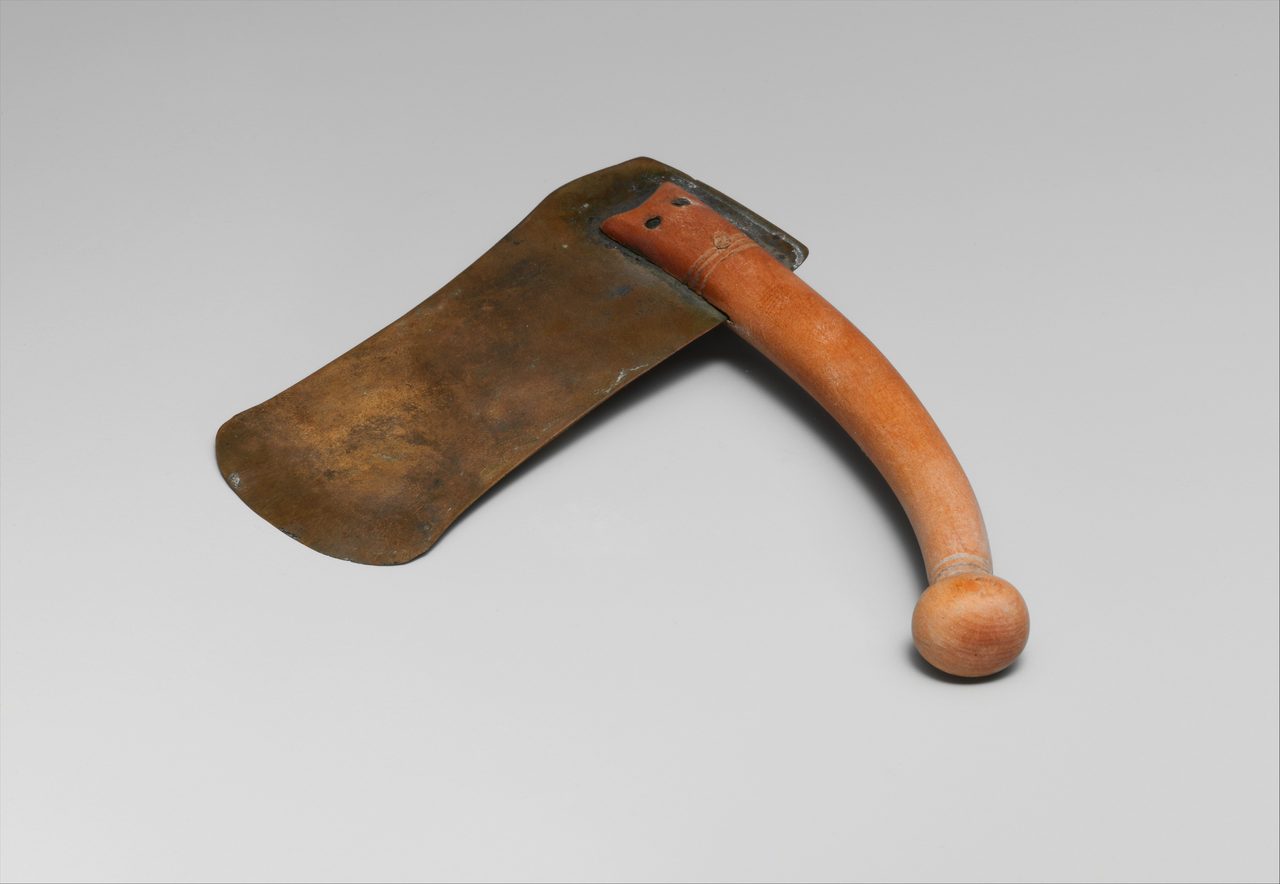
The razor of Hatnefer, in bronze or copper alloy with a boxwood handle, about 1491 to 1473 BCE. It was found inside a basket in the tomb of Hatnefer and Ramose at Thebes.
- Image:
- Razor belonging to Hatnefer, bronze or copper alloy and boxwood, Egypt, ca. 1491 to 1473 BCE. The Metropolitan Museum of Art, 36.3.69.
- Source:
- The Met’s record 36.3.69; US Patent 775,134 (15 November 1904)
The razor at the top of this page is about 3,500 years old. What a US patent of 15 November 1904 added was a blade cheap enough to throw away when dull. In the sources below a shave means a barber, a pair of pincers or tweezers, or an edge its owner has to hone. What Egypt, Rome, India, the Islamic world, Japan, China, the Americas and France did about hair on the face and head, with the original beside our English wherever we quote.
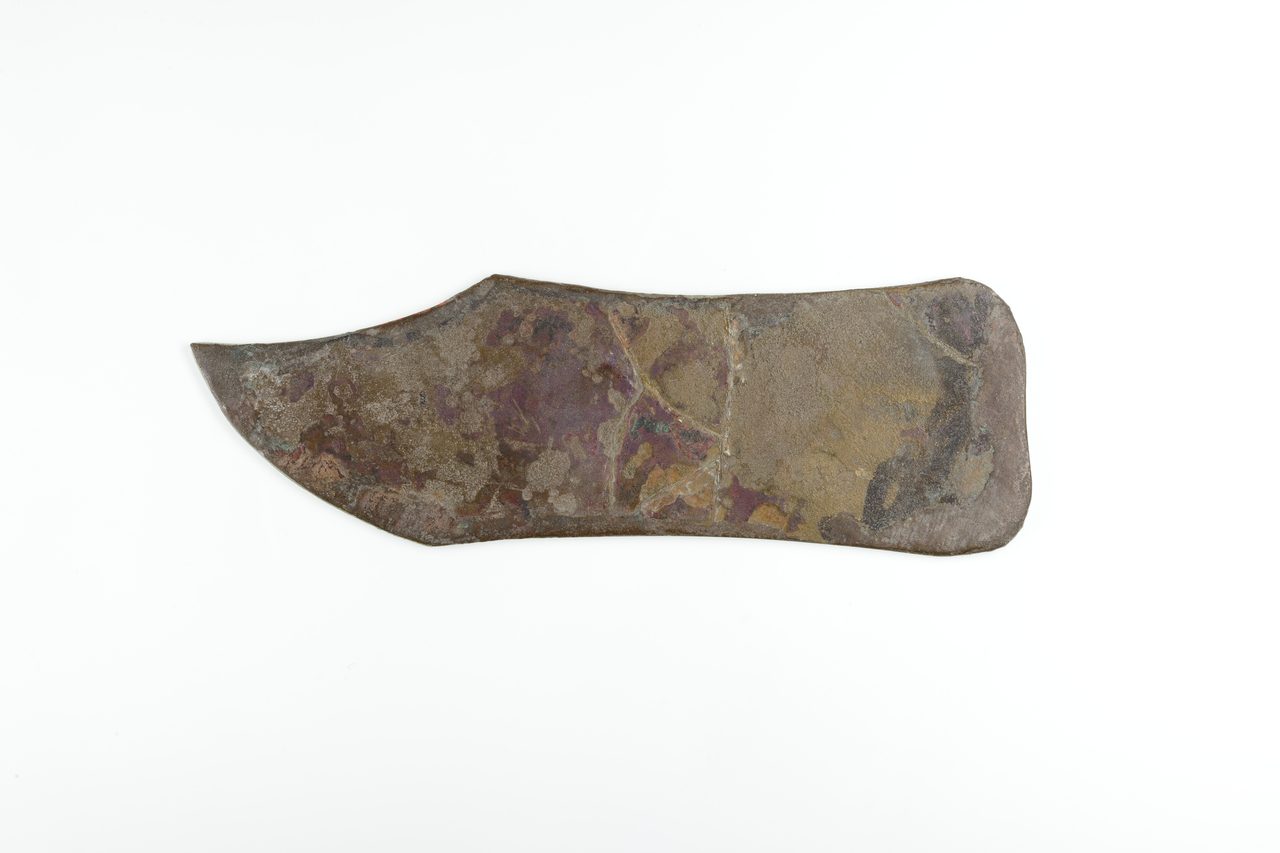
Ruiu’s razor, a flat blade of bronze or copper alloy from the burial of Ruiu at Thebes, about 1504 to 1447 BCE.
- Image:
- Ruiu’s razor, bronze or copper alloy, Egypt, ca. 1504 to 1447 BCE. The Metropolitan Museum of Art, 35.3.55.
- Source:
- Herodotus, Histories 2.36 to 2.37, tr. A. D. Godley (1920)
Egypt: shaved priests, and a razor in a basket
Herodotus, a Greek visitor of the 5th century BCE, wrote about Egypt as an outsider: “Everywhere else, priests of the gods wear their hair long; in Egypt, they are shaven. For all other men, the rule in mourning for the dead is that those most nearly concerned have their heads shaven; Egyptians are shaven at other times, but after a death they let their hair and beard grow.” The first sentence is about priests, the second about everyone. Of the priests he adds: “Their priests shave the whole body every other day, so that no lice or anything else foul may infest them as they attend upon the gods.” (Histories 2.36 and 2.37, tr. A. D. Godley, 1920.)
In Genesis, Joseph is fetched to Pharaoh: “And he shaved himself, and changed his raiment” (Genesis 41:14, Jewish Publication Society translation of 1917). The Hebrew verb is וַיְגַלַּח.
The Metropolitan Museum of Art’s excavations of 1935 to 1936 found the razor above in the tomb of Ramose and Hatnefer, the parents of Senenmut; Hatnefer was his mother (after W. C. Hayes, The Scepter of Egypt II, 1959, and the Met’s record). The record places it inside a basket. A second razor from Thebes, Ruiu’s, is of the same decades.
Rome: barbers from Sicily, then the beard returns
Varro, in De re rustica, has just finished with the shearing of sheep:
“Barbers, at any rate, are said to have come to Italy first from Sicily in the 453rd year after the founding of Rome, as stands written in a public place at Ardea, and Publius Titinius Mena is said to have brought them. That there were once no barbers is shown by the statues of the ancients, since most of them have a head of hair and a big beard.”
Varro, De re rustica 2.11.10, 1st century BCE. Our translation.
Omnino tonsores in Italiam primum venisse ex Sicilia dicuntur p. R. c. a. CCCCLIII, ut scriptum in publico Ardeae in litteris extat, eosque adduxisse Publium Titinium Menam. Olim tonsores non fuisse adsignificant antiquorum statuae, quod pleraeque habent capillum et barbam magnam.
The 453rd year of the city is about 300 BCE. Varro is reporting what is said. Pliny the Elder gives the next year: “According to Varro, they were introduced into Italy from Sicily, in the year of Rome 454”. He goes on: “The younger Africanus was the first who adopted the custom of shaving every day. The late Emperor Augustus always made use of razors.” (Natural History 7.59, tr. John Bostock and H. T. Riley, 1855.) The “first” is Pliny’s.
A Roman on trial was expected to let his beard grow. Aulus Gellius writes that Scipio, “although he was under accusation, neither ceased to shave his beard and to wear white raiment nor appeared in the usual garb of those under accusation.” Gellius was puzzled by it: “But since it is certain that at that time Scipio was less than forty years old, I was surprised at the statement about shaving his beard. I have learned, however, that in those same times the other nobles shaved their beards at that time of life” (Attic Nights 3.4, tr. J. C. Rolfe, 1927).
Martial has a joke about a barber called Eutrapelus, here in an anonymous English verse of 1695: “Eutrapelus, the barber, works so slow, / That while he shaves, the beard anew does grow.” (Epigrams 7.83, as printed in Bohn’s Classical Library.) And Suetonius has a first shave made into a ceremony. At a gymnastic contest Nero “shaved his first beard to the accompaniment of a splendid sacrifice of bullocks, put it in a golden box adorned with pearls of great price, and dedicated it in the Capitol.” (Nero 12.4, tr. J. C. Rolfe, 1914.)
Then the beard came back. The Cleveland Museum of Art’s record for the head below says: “Beards were uncommon in Rome until the emperor Hadrian (r. 117–38 CE) popularized them”. The Historia Augusta, a late and weak source, claims a reason:
“He was tall, elegant in appearance, with his hair curled with a comb and his beard grown long to cover the natural blemishes on his face, and strongly built.”
Historia Augusta, Life of Hadrian 26.1. Our translation.
Statura fuit procerus, forma comptus, flexo ad pectinem capillo, promissa barba, ut vulnera, quae in facie naturalia erant, tegeret, habitudine robusta.
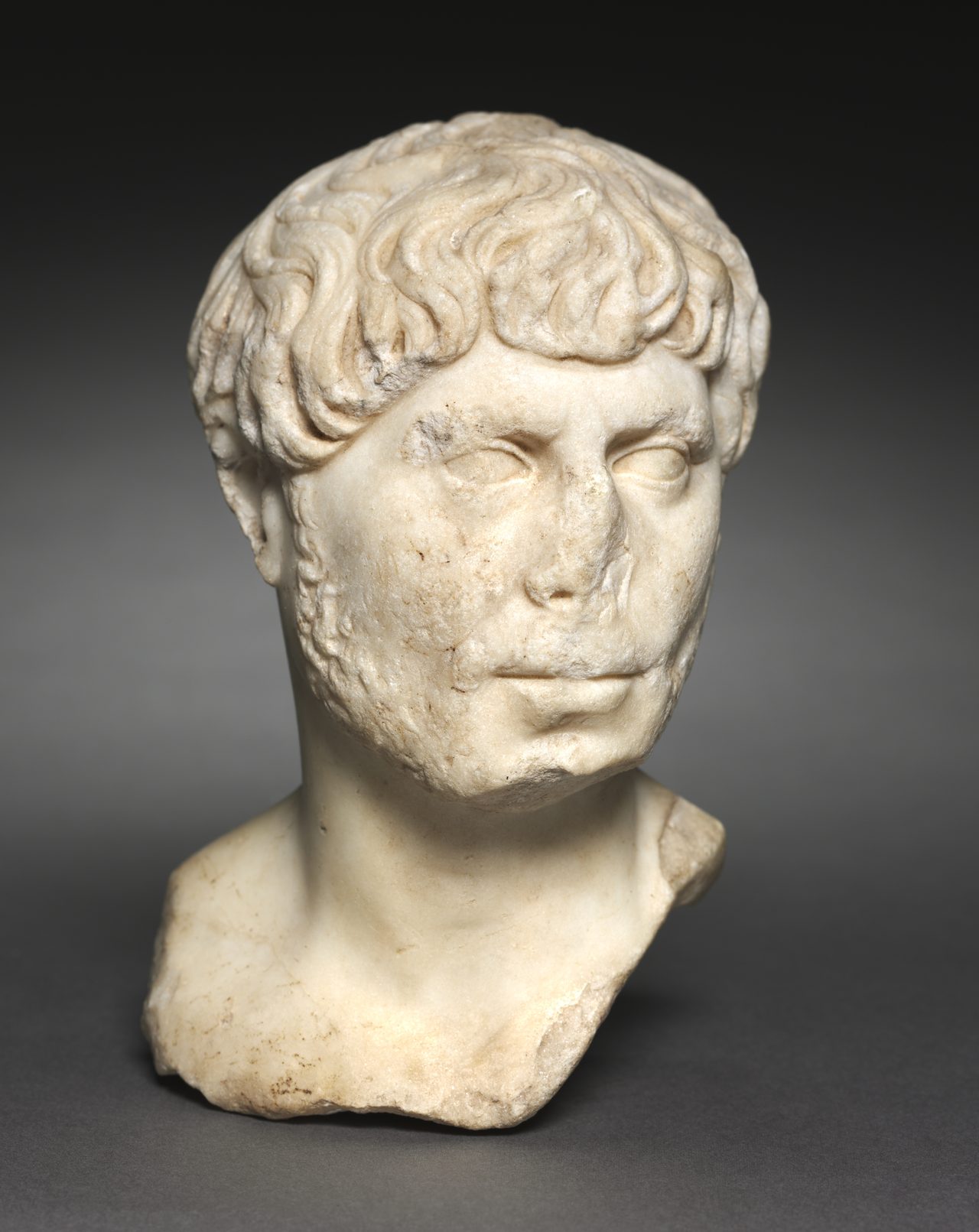
The head of a bearded man in marble, Roman, about 125 CE. By the Cleveland Museum of Art’s record he was first thought to be Hadrian, but the face is too angular.
- Image:
- Head of a bearded man, marble, Roman, c. 125 CE. The Cleveland Museum of Art, 1924.535.
- Source:
- Varro, De re rustica 2.11.10, our translation; Pliny, Natural History 7.59, tr. Bostock and Riley (1855)
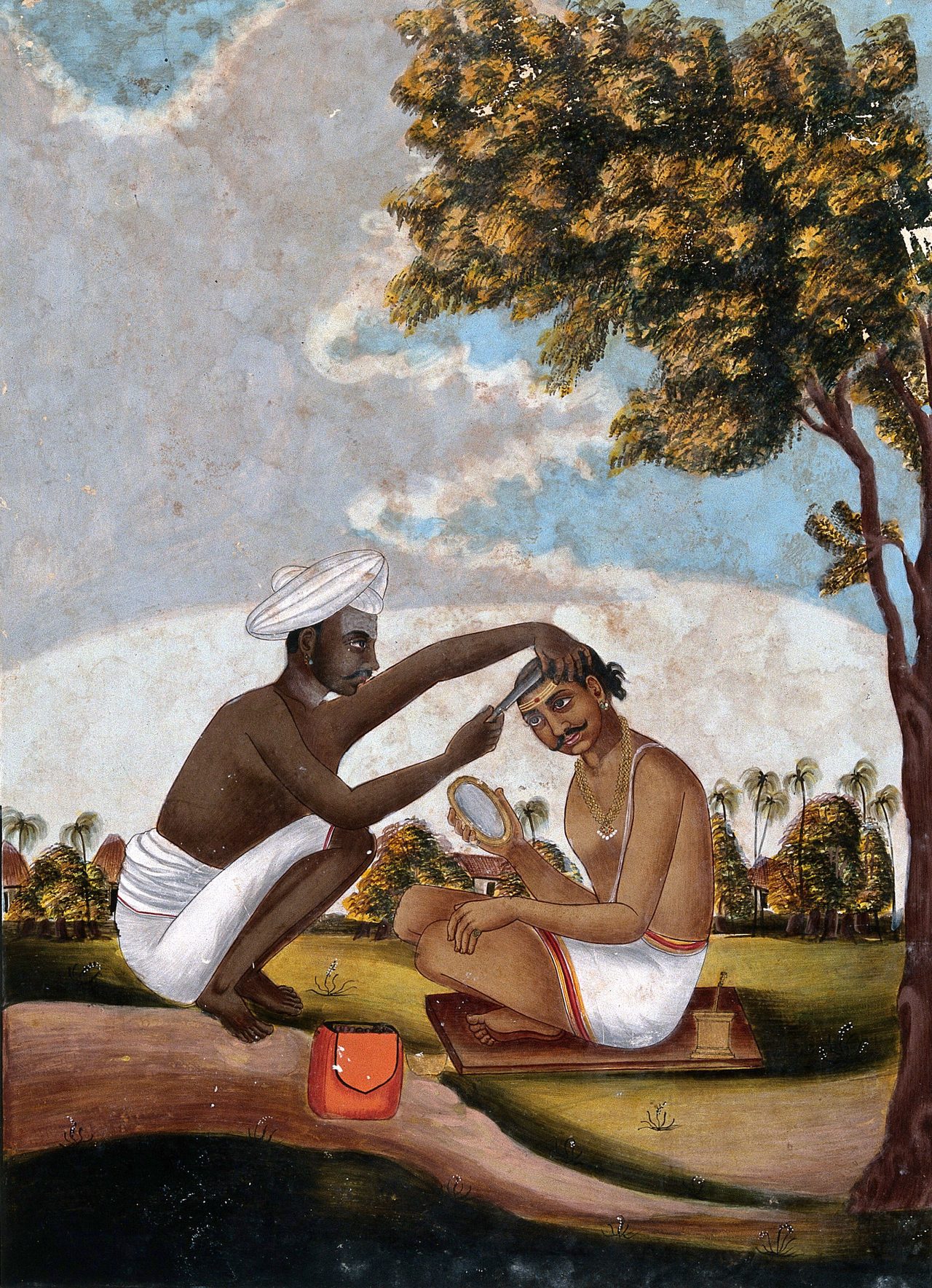
A barber shaves a man’s head while the man holds his own mirror, in a gouache attributed to a painter from Tanjore, about 1840. A picture of its own day, not of the monks’ rules.
- Image:
- A painter from Tanjore, a barber shaving a man’s head, gouache, ca. 1840. Wellcome Collection. Public Domain Mark.
- Source:
- Cullavagga V.27, tr. T. W. Rhys Davids and Hermann Oldenberg (1885)
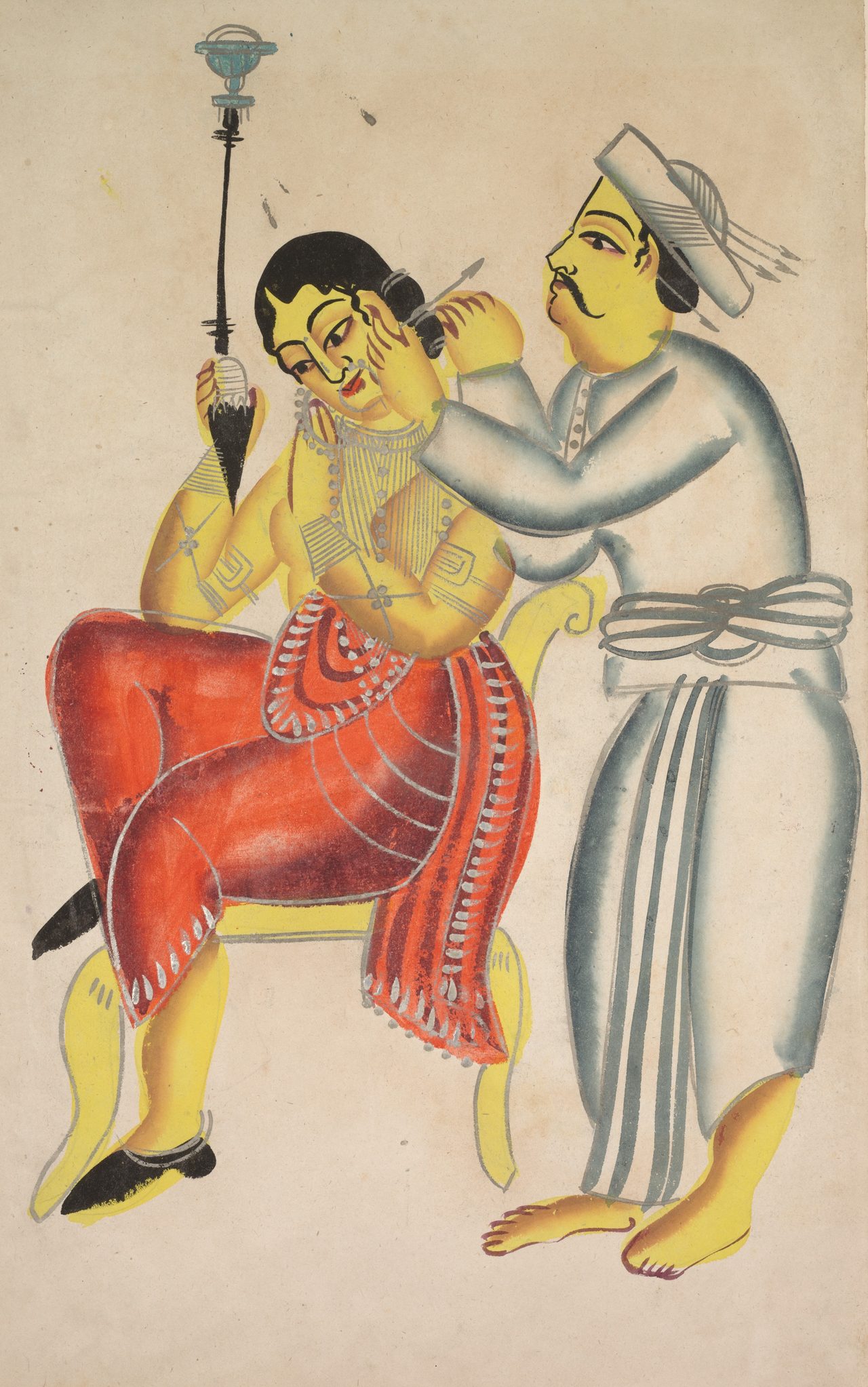
A barber cleans a woman’s ear in a Kalighat painting of about 1890. A satire: the Cleveland Museum of Art’s record reads the scene as one about neglected wives relying on their servants.
- Image:
- Barber cleaning a woman’s ear, gum tempera, ink and tin on paper, Kalighat, Kolkata, c. 1890. The Cleveland Museum of Art, 2003.117.
India: razors in the monks’ rules
The Cullavagga, a book of the Buddhist monks’ rules, has the monks asked whether they can remove one another’s hair. They answer “They are, Lord”, and the Buddha allows “the use of razors, of a hone to sharpen the razors on, of powder prepared with Sipatika-gum to prevent them rusting, of a sheath to hold them in, and of all the apparatus of a barber.” The same pages list what is not allowed. Beards are not to be cut by barbers, grown long, worn “like a goat’s beard” or with “four corners”, and monks are not “to cut the hair on your bellies into figures”. Of long nostril hair, people said: “Like the devil-worshippers!” (Cullavagga V.27, tr. T. W. Rhys Davids and Hermann Oldenberg, 1885.)
In another chapter the Sakya youths ask that “Upali the barber” be ordained before them, “and thus shall the Sakya pride be humbled in us Sakyans”. So “the Blessed One received first Upali the barber” (Cullavagga VII.1.4, same translation).
The Kama Sutra’s citizen has his head and face shaved every four days and the rest of his body every five or ten (after Part I, ch. IV, in the Kama Shastra Society’s English of 1883).
The record of the Kalighat painting describes “A chinless barber with cleaning pins tucked in his turban”. The barber’s work in it is ears, not beards.
The Islamic world: which hair
Sahih al-Bukhari gives this saying of the Prophet Muhammad on the fitra, the natural way:
“From Abu Hurayra (God be pleased with him): I heard the Prophet (God bless him and give him peace) say: ‘The fitra is five things: circumcision, shaving the pubic hair, trimming the moustache, clipping the nails and plucking the armpit hair.’”
Sahih al-Bukhari 5891. Our translation.
عَنْ أَبِي هُرَيْرَةَ ـ رضى الله عنه ـ سَمِعْتُ النَّبِيَّ صلى الله عليه وسلم يَقُولُ "الْفِطْرَةُ خَمْسٌ الْخِتَانُ، وَالاِسْتِحْدَادُ، وَقَصُّ الشَّارِبِ، وَتَقْلِيمُ الأَظْفَارِ، وَنَتْفُ الآبَاطِ".
The next entry is about the beard:
“From Ibn Umar: the Prophet (God bless him and give him peace) said, ‘Be different from the polytheists: let the beards grow full and trim the moustaches close.’ And whenever Ibn Umar made the hajj or the umra, he would grip his beard in his fist and take off whatever stuck out beyond it.”
Sahih al-Bukhari 5892. Our translation.
عَنِ ابْنِ عُمَرَ، عَنِ النَّبِيِّ صلى الله عليه وسلم قَالَ "خَالِفُوا الْمُشْرِكِينَ، وَفِّرُوا اللِّحَى، وَأَحْفُوا الشَّوَارِبَ". وَكَانَ ابْنُ عُمَرَ إِذَا حَجَّ أَوِ اعْتَمَرَ قَبَضَ عَلَى لِحْيَتِهِ، فَمَا فَضَلَ أَخَذَهُ.
The head is another matter. The Qur’an, in Marmaduke Pickthall’s translation of 1930: “Ye shall indeed enter the Inviolable Place of Worship, if Allah will, secure, (having your hair) shaven and cut, not fearing.” (48:27; the brackets are Pickthall’s.) Shaven and cut are the pilgrim’s two choices at the end of ihram, the pilgrim’s state, and the chapter of al-Bukhari on that moment ranks them:
“From Abd Allah ibn Umar (God be pleased with them both): the Messenger of God (God bless him and give him peace) said, ‘O God, have mercy on those who shave.’ They said, ‘And those who shorten, Messenger of God?’ He said, ‘O God, have mercy on those who shave.’ They said, ‘And those who shorten, Messenger of God?’ He said, ‘And those who shorten.’ Al-Layth said: Nafi told me, ‘May God have mercy on those who shave,’ once or twice. He said: and Ubayd Allah said: Nafi told me, and he said on the fourth time, ‘And those who shorten.’”
Sahih al-Bukhari 1727. Our translation.
عَنْ عَبْدِ اللَّهِ بْنِ عُمَرَ ـ رضى الله عنهما ـ أَنَّ رَسُولَ اللَّهِ صلى الله عليه وسلم قَالَ "اللَّهُمَّ ارْحَمِ الْمُحَلِّقِينَ". قَالُوا وَالْمُقَصِّرِينَ يَا رَسُولَ اللَّهِ قَالَ "اللَّهُمَّ ارْحَمِ الْمُحَلِّقِينَ". قَالُوا وَالْمُقَصِّرِينَ يَا رَسُولَ اللَّهِ قَالَ "وَالْمُقَصِّرِينَ". وَقَالَ اللَّيْثُ حَدَّثَنِي نَافِعٌ "رَحِمَ اللَّهُ الْمُحَلِّقِينَ" مَرَّةً أَوْ مَرَّتَيْنِ. قَالَ وَقَالَ عُبَيْدُ اللَّهِ حَدَّثَنِي نَافِعٌ وَقَالَ فِي الرَّابِعَةِ "وَالْمُقَصِّرِينَ".
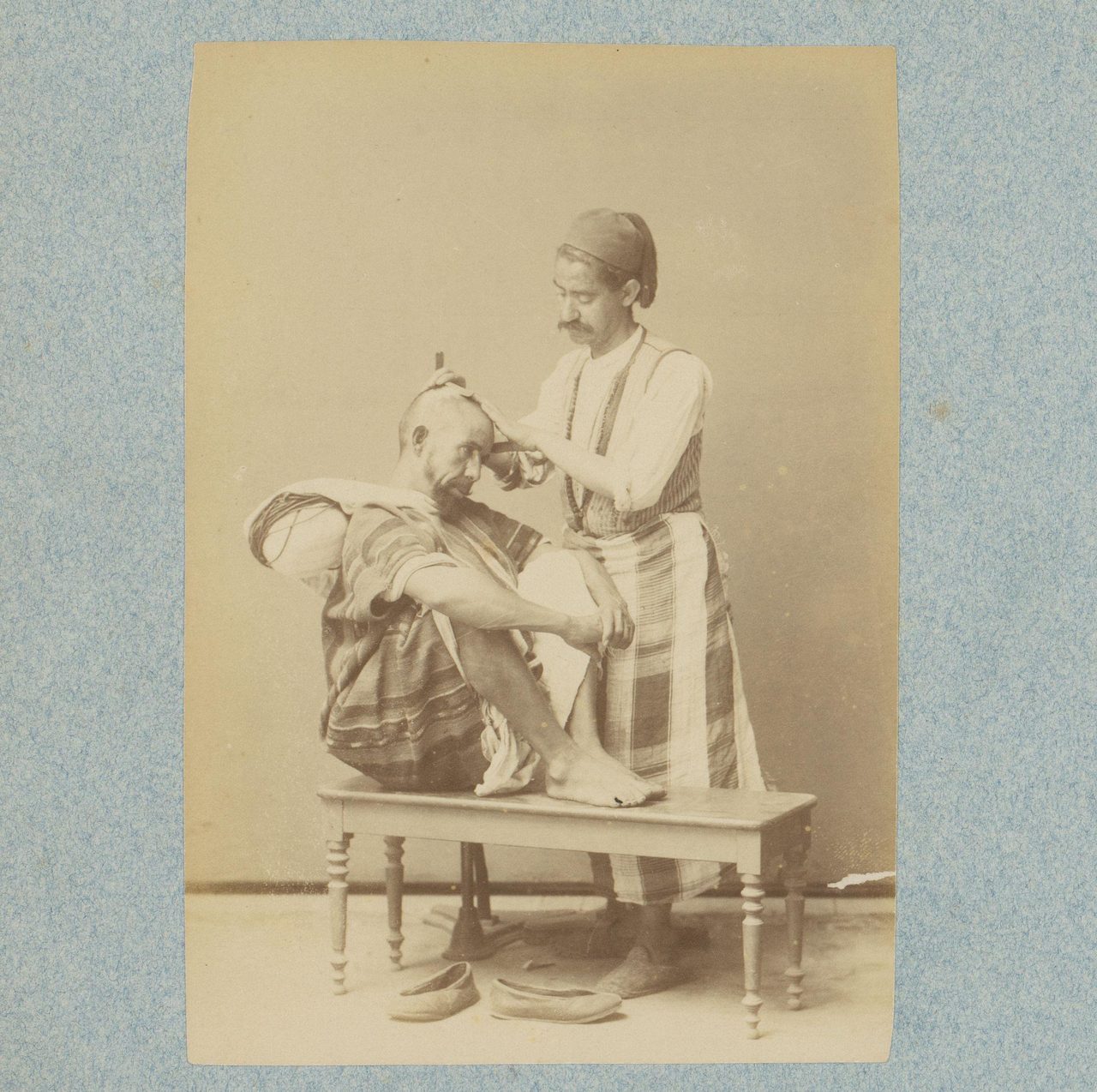
A barber shaves a man’s head in Algiers, in an albumen print of 1851 to 1900. The Rijksmuseum’s record gives its inscriptions as Barbier and Alger.
- Image:
- Anonymous, a barber shaving a man’s head, Algiers, albumen print, 1851 to 1900. Rijksmuseum, RP-F-00-12305.
- Source:
- Sahih al-Bukhari 5892 and 1727. Our translations
Those who shorten are added only on the third time, or the fourth in the other version the entry records.
Japan: wooden pincers, then tweezers
Miura Jōshin’s Keichō kenmonshū counts the years from his birth to “this year”, 1614. One chapter of book 4 is headed with its subject: why men today have no beards. It opens with the hair of the head:
“What I saw long ago: when this foolish old man was young, in the Kantō, men did not shave the hair of the forehead and the head, even with a razor. They made big pincers out of wood, called ketsushiki, and when they plucked the hair of the head with these, black blood ran from the head, a dreadful thing to see. Heads were like gourds, and having no hair was held to be the proper style for a man.”
Miura Jōshin, Keichō kenmonshū, 1614, book 4. Our translation.
見しは昔、愚老若き比關東にて、をのこの額毛頭の毛をば髮剃にてもそらず、けつしきとて木を以てはさみを大にこしらへ、其けつしき頭の毛をぬきつれば、かうべより黑血流れて物すさまじかりし也。頭はふくべの如くにて、毛のなきを男の本意風俗とす。
Ketsushiki is our reading of けつしき; the kana do not settle how the word was said. Miura gives the style and no reason for it. The beard, in those same years, was wanted:
“And a man who had grown a beard was praised as a fierce-looking bearded man, so everyone longed for a beard. [...] And a man whose beard would not grow they mocked and laughed at as ‘woman-face’. [...] So it was that in the Tenshō years, at Odawara, two men called Iwasaki Kazaemon and Katai Rokurobei went from joking to quarrelling. Kazaemon had no beard, and when Rokurobei swore at him, ‘That no-beard!’, they at once stabbed each other, and both died. For a man, being called beardless was felt to be as great a disgrace as being called a coward.”
Miura Jōshin, Keichō kenmonshū, 1614, book 4. Our translation.
扨又髭はえたる人をば、面にく體髭男と云てほむる故に、皆人髭を願ひ給へり。[...] 又ひげはえぬをばをんなづらと云てあざらひ笑ふ。[...] されば天正の頃ほひ、小田原にて岩崎嘉左衞門、片井六郞兵衞といふもの、ざれごとを云あがりいさかふ。嘉左衞門が髭なし、六郞兵衞あの髭なしと惡口しければ、卽時にさしちがへ死たり。さる程に男たる人の髭なしといはるゝは、おく病者といはるゝ程のちじよくに思ひ給へり。
One insult is recorded, and two deaths. By the time Miura wrote, both fashions had turned over:
“For these fourteen or fifteen years the young have laughed at a head with no hair on it, with nicknames such as ‘old man’s bald pate’ and ‘fly-slide’. And it has become the saying that a bearded face is a dull face, just like the people of Ezo island, and they pluck out every hair of beard and moustache with tweezers and throw it away. So when you see someone in a hat with the head wrapped, you can hardly tell whether it is a monk, a man or a woman.”
Miura Jōshin, Keichō kenmonshū, 1614, book 4. Our translation.
此十四五年此方頭に毛のなきを、年寄のきんかつぶり、はへすべりなどと、あだ名を云て若き人達笑ふ。扨髭はえたるつらはどんなるつら、えぞが島の人によく似たりと云ならはし、上下の髭殘さず毛拔にてぬき捨る。然間笠を著、頭包みたる人をみれば、法師とも男女とも見分がたし。
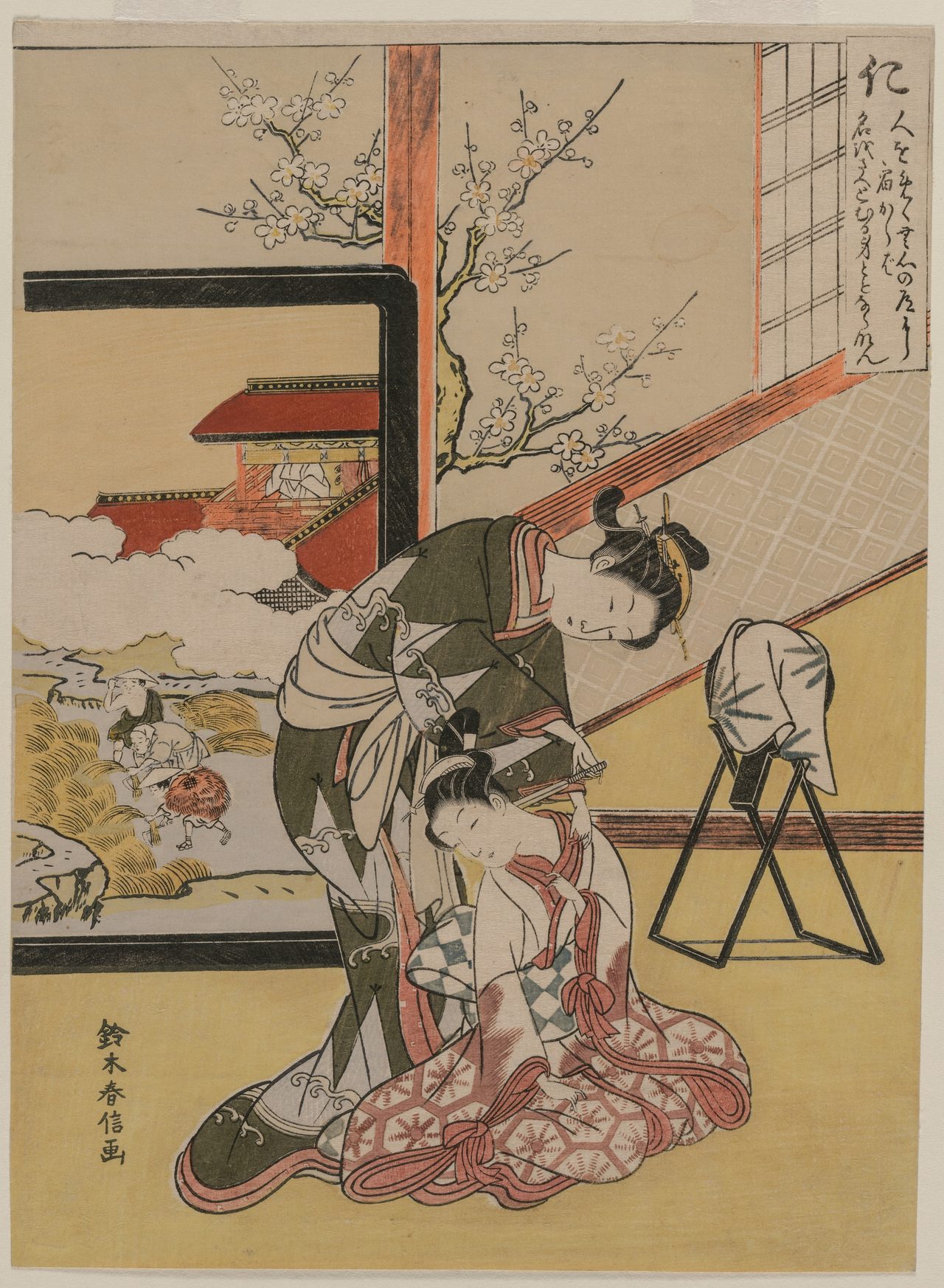
Benevolence, from The Five Virtues, by Suzuki Harunobu, 1767: a woman draws a razor across the nape of a kneeling girl. A razor at work, not the pincers Miura describes.
- Image:
- Suzuki Harunobu, Benevolence, from The Five Virtues, colour woodblock print, 1767. The Cleveland Museum of Art, 1949.124.
- Source:
- Miura Jōshin, Keichō kenmonshū (1614), book 4, our translation
The line about a dull face is a saying of the day that Miura reports, not his own view.
A century and a half later Suzuki Harunobu drew a shave indoors. By the Cleveland Museum of Art’s record, “a courtesan demonstrates benevolence by shaving her attendant’s neck.”
An undated photograph of Japanese barbers in the Wellcome Collection carries an outsider’s note in English, pasted on its back: “Most Japanese are shaved daily, and in addition to the head, the face and even the nose is shaved, the ears are bored out, and the eyelids often turned back and scraped”. The claim is the note-writer’s.
China: an order withdrawn in 1644, and ten days in 1645
The Veritable Records of the Shunzhi reign enter an order to shave at Tongzhou and its withdrawal in the same month of 1644:
“Shunzhi 1 (jiashen year), 5th month, 1st day (wuzi). [...] The army of the Prince Regent, Dorgon, reached Tongzhou. The department magistrate led the people out to surrender and welcome it, and he ordered them to shave the head. [...] Xinhai (24th day). [...] He also instructed the Board of War: ‘[...] Earlier, because the people who had submitted could not be told apart, I ordered them to shave the head, to tell the obedient from the rebellious. Now I hear that this goes very much against the people’s wishes, the opposite of my true purpose, which is to settle the people by civil means. From now on the officials and people of the realm may bind up their hair as before, each as they please.’”
Qing shilu, Shizu shilu, juan 5. Our translation.
顺治元年甲申。五月戊子朔。[...] 摄政和硕睿亲王多尔衮师至通州知州率百姓迎降谕令薙发。[...] ○辛亥。[...] ○又谕兵部曰。[...] 予前因归顺之民、无所分别。故令其薙发、以别顺逆。今闻甚拂民愿、反非予以文教定民之本心矣。自兹以后、天下臣民、照旧朿发。悉从其便。
The text we read prints 朿, which we take as 束, to bind. In 1645, on the report of victory in Jiangnan, the order came back, first to the army:
“Bingchen (5th day). On the report of victory in Jiangnan, the guards Niyada, Feiyanggu and others were sent with an edict for Dodo, Prince Yu, and the others. The edict said: [...] ‘Everywhere, civil and military officials, soldiers and people are all to be made to shave the head. Should any refuse, deal with them by military law.’”
Qing shilu, Shizu shilu, juan 17. Our translation.
○丙辰。以江南奏捷。遣侍卫尼雅达、费扬古等、赍敕往谕和硕豫亲王多铎等。敕曰 [...] 各处文武军民、尽令薙发。傥有不从、以军法从事。
The edict names military law and no penalty beyond it. Ten days later a second edict went to the Board of Rites:
“Bingyin (15th day). An edict to the Board of Rites: ‘Until now the rule of shaving the head was not made uniform at once, and people were left to suit themselves, because we wished to wait until the realm was fully settled before enforcing it. Now inside and outside are one family. The ruler is like the father and the people like the children; father and children are one body, so how can they differ? If they are not made uniform, in the end they will be of two minds, and will they not be almost the people of another country? There is no need for us to say this; we expect the officials and people of the realm know it themselves. From the day this is proclaimed: in and around the capital, within ten days; in Zhili and the provinces, within ten days of the day the Board’s letter arrives. All are to shave the head. Those who comply are people of our state; those who hesitate are the same as rebels who defy our command, and will certainly be severely punished. Whoever dodges it to spare his hair, or argues with clever words, will by no means be lightly forgiven, and the civil and military officials of each place are all to inspect strictly. Should anyone raise this matter again and presume to send up memorials, wishing the people of places we have settled to keep the Ming style and not follow the rules of this dynasty: kill without pardon.’”
Qing shilu, Shizu shilu, juan 17. Our translation.
○丙寅。谕礼部曰向来矱发之制、不即令画一姑听自便者、欲俟天下大定始行此制耳今中外一家君犹父也民犹子也父子一体、岂可违异。若不画一终属二心。不几为异国之人乎。此事无俟朕言想天下臣民亦必自知也。自今布告之后、京城内外限旬日。直隶各省地方、自部文到日、亦限旬日。尽令矱发。遵依者、为我国之民。迟疑者、同逆命之寇必置重罪。若规避惜发、巧辞争辨决不轻贷该地方文武各官皆当严行察验。若有复为此事、渎进章奏。欲将朕已定地方人民、仍存明制、不随本朝制度者、杀无赦。
In this edict the text we read prints 矱 where the word is 薙, to shave. Its harshest words, “kill without pardon”, are aimed at anyone who petitions to keep the Ming style.
What followed in one county is told in the Haijiao yibian, an anonymous Qing chapter-narrative of Changshu. It is a narrative with a verse at its head, not a plain record, and the year 1645 is by its context:
“The shaving order is first proclaimed; the Qing court makes new laws. Keep your body and lose your hair; keep your hair and lose your body. [...] Nearest Fushan was the 22nd district, where the sea forces were camped at the time, and its people were all unshaven. The 24th district lay halfway, and the shaven and the unshaven lived mixed together, about half and half. When Qing soldiers saw an unshaven man they killed him and took the head to claim a reward as a pirate’s head; they called this ‘catching for a shave’. When the sea forces saw a shaven man they killed him and took the head to claim a reward as a Tartar’s head; they called this ‘looking at bare heads’. Meeting on the road, everyone would turn to look at whether the other’s neck was bare or not.”
Haijiao yibian, chapter 57, anonymous, Qing. Our translation.
剃髮令初申,清朝立法新。留身不留髮,留髮不留身。[...] 近福山為二十二都,海上兵現住紮營,百姓俱係未剃髮的。二十四都居中途,剃髮者與未剃髮者雜處,大約各居其半。清兵見未剃髮者便殺,取頭去作海賊首級請功,名曰:「捉剃頭」。海上兵見已剃髮者便殺,拿頭去做韃子首級請功,號曰「看光頭」。途中相遇,必大家回頭,看頸之光與不光也。
A later emperor, Qianlong, recalled the conquest in an edict punishing officials who had shaved during the hundred days of mourning for an empress. “Over a hundred years” is his own count:
“It is the fixed rule of our dynasty that in a time of national mourning no one shaves the head within the hundred days. Anyone who breaks the rule and privately offends against the ancestral law is to be beheaded at once, on the same principle as when, at our entry through the Pass, the Han were ordered to shave the head, and of those who did not shave, none escaped beheading. For over a hundred years everyone has kept this, and understood it without waiting for an edict to be sent round.”
Huangchao tongdian, juan 62, edict of the Qianlong emperor. Our translation.
本朝定制遇有國恤百日以内皆不薙頭倘違例私犯祖制立即處斬亦如進關時令漢人薙髮彼不薙髮者無不處斬之理此百餘年人所共遵不待傳諭而後曉
That none escaped is the emperor’s claim.
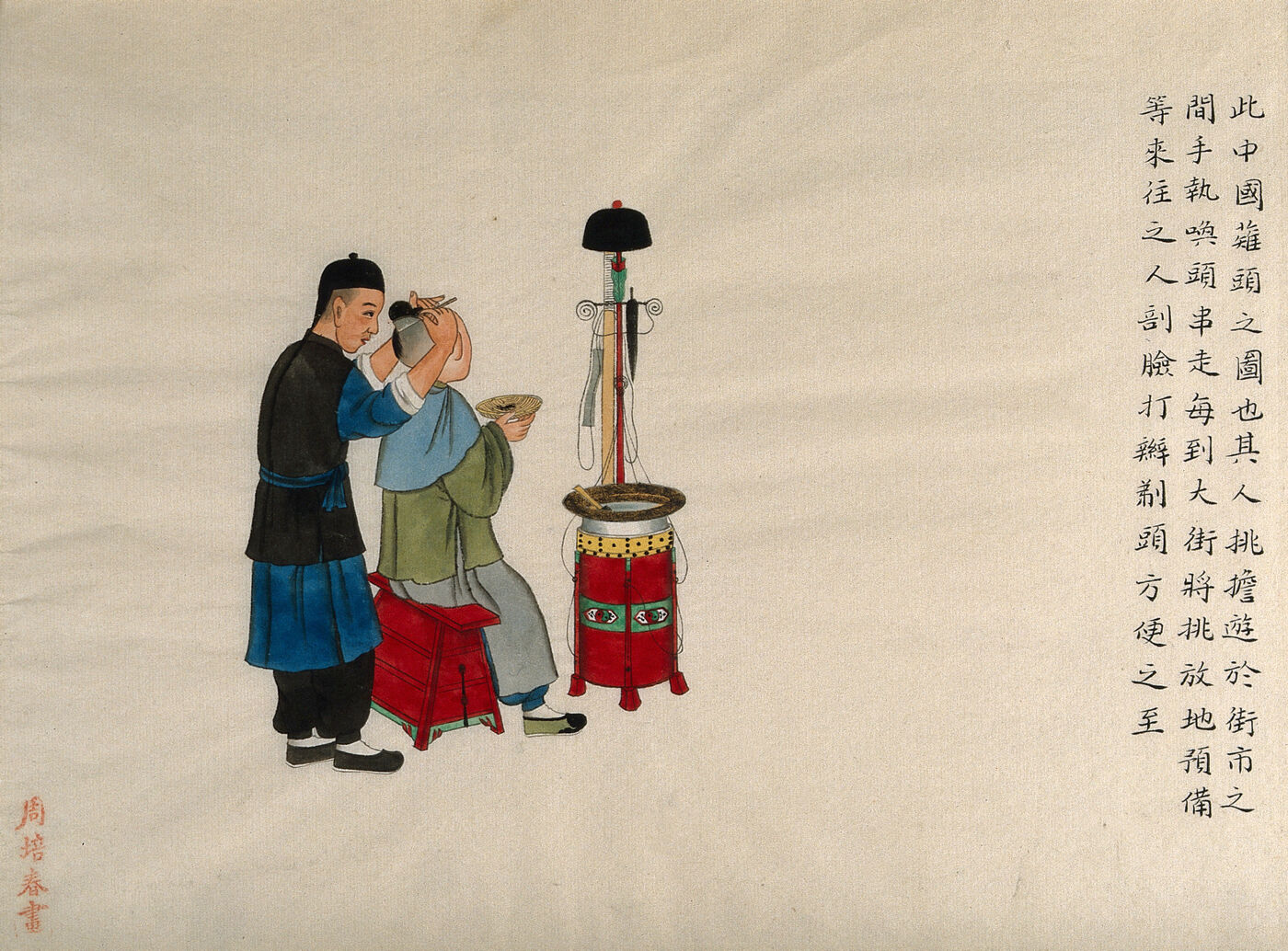
About 1890 Zhou Pei Qun painted a street barber, and the inscription on the sheet says what the picture shows:
“This is a picture of Chinese head-shaving. The man carries his load on a shoulder pole and roams the streets and markets, the call-iron in his hand. At each main street he sets the load down and waits, ready for passers-by: shaving the face, plaiting the queue, shaving the head. Most convenient.”
Zhou Pei Qun, inscription on a watercolour, about 1890. Our translation.
此中國薙頭之圖也其人挑擔遊於街市之間手執喚頭串走每到大街將挑放地預備等来往之人剖臉打辮剃頭方便之至
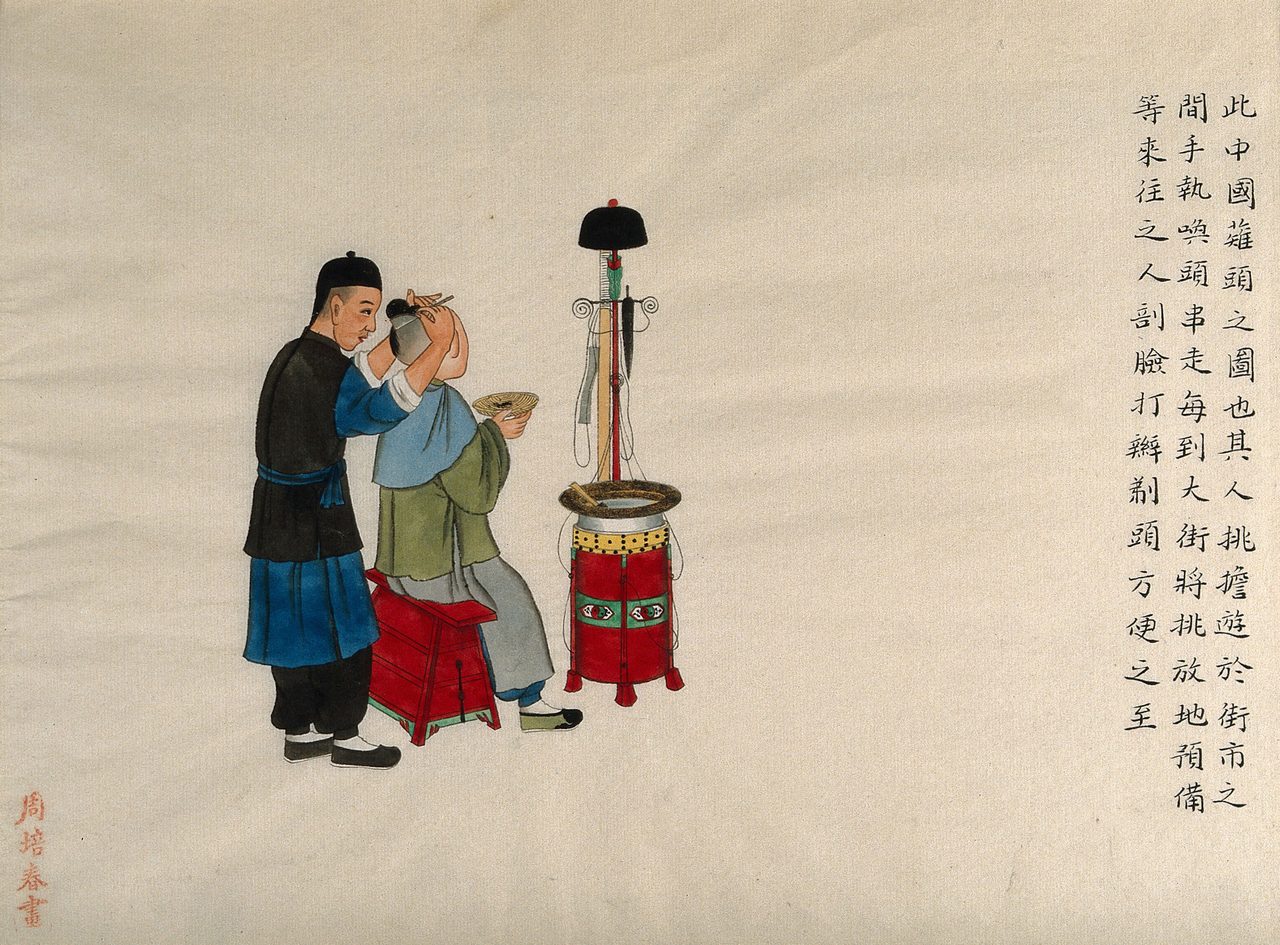
A street barber shaves the front of a client’s head in the Manchu style, with his stand beside him, in a watercolour by Zhou Pei Qun, about 1890. The three columns at the right are the inscription translated above.
- Image:
- Zhou Pei Qun, a street barber shaving a man’s head in the Manchu style, watercolour, ca. 1890. Wellcome Collection. Public Domain Mark.
- Source:
- Qing shilu, Shizu shilu, juan 5 and 17. Our translations
The Americas: two outsiders
Hernán Cortés, in his Second Letter of 1520, describes Tenochtitlan as a conqueror: “There are places like our barber’s shops, where they wash and shave their heads”. At Tlaxcala he saw “houses like barbers’ shops, where they wash their heads and shave themselves” (tr. Francis Augustus MacNutt, 1908). He names no blade.
George Catlin, writing in 1841 of the forty-eight tribes he had visited, describes plucking. A man who had missed the moment “subjects his chin to the repeated pains of its extractions, which he is performing with a pair of clamshells or other tweezers, nearly every day of his life” (Letters and Notes, vol. 2, p. 227). Both men are outsiders. We found no open image of people shaving or plucking in the Americas, so this section has no picture.
Paris, 1769: learning to shave yourself
Jean-Jacques Perret was a master cutler in Paris. In 1769 he published La Pogonotomie, ou l’art d’apprendre à se raser soi-même, the art of learning to shave yourself. He sold razors, and his preface makes the case against the barber’s:
“[...] but what troubles does it not bring? How many people catch, through razors and soap-balls that have been used to shave unhealthy people, scaly skin eruptions, pimples and sometimes deadly diseases, which pass into the mass of the blood and wreak cruel havoc there? [...] But what is certain is that men who shave themselves have a smoother and more pleasing face than those who have themselves shaved by other people’s hands.”
Perret, La Pogonotomie, 1769, preface. Our translation.
[...] mais quels inconvéniens n'en résulte-t-il pas? combien de gens gagnent, par le moyen des rasoirs & savonnettes qui ont servi à raser des personnes mal saines, des dartres, des boutons, & quelquefois des maladies funestes, qui passent dans la masse du sang, & y font des ravages cruels? [...] Mais ce qu'il y a de certain, c'est que les hommes qui se rasent eux-mêmes, ont le visage uni & plus ragoûtant, que ceux qui se font raser par des mains étrangeres.
The claims about disease are Perret’s. For the beginner’s cuts he offers a razor of his own:
“It was to spare new barbers the unpleasantness of these cuts to the face that I invented, in 1762, the plane razor, which is certainly very handy for learning to shave yourself, because it has the advantage of shaving well, and as close as you like, without risk of cutting yourself.”
Perret, La Pogonotomie, 1769, preface. Our translation.
C'est pour épargner aux nouveaux Barbiers le désagrément de ces coupures au visage, que j'inventai, en 1762, le rasoir à rabot (*) qui est certainement très-commode pour apprendre à se raser soi-même, parce qu'il a l'avantage de bien raser, & aussi près que l'on veut, sans risque de se couper.
His new barbers are beginners shaving themselves. The name comes from the tool it looks like:
“Figure 13 shows the razor fully assembled and in the position for shaving with it. This kind of casing gets it the name of plane razor, from its likeness to the joiner’s plane.”
Perret, La Pogonotomie, 1769, ch. VII. Our translation.
La figure 13 représente le rasoir tout monté & dans la situation propre à s'en raser. Cette espece de châsse lui fait donner le nom de rasoir à rabot par connection avec le rabot du Menuisier.
The Wellcome Collection’s copy has no plates, so figure 13 cannot be shown here. A footnote to the preface settles a score:
“See the Mercure of April 1762. M. Moreau, my colleague, announced himself as the inventor in the sheets of the Avant-Coureur for March; but his only part in it was to send someone to buy one at my shop, pretending to have been sent by M. de la Place, of the Mercure, and then to copy it. All his glory (if it is glory to be a plagiarist) came down to passing, for the space of a month, as the inventor of an instrument that had cost him only six livres to buy.”
Perret, La Pogonotomie, 1769, preface, note. Our translation.
Voyez le Mercure d'Avril 1762. M. Moreau, mou confrere, s'est annoncé comme Auteur de cette invention, dans les feuilles de l'avant-Coureur du mois de Mars; mais il n'y a eu d'autre part que d'envoyer un particulier en acheter un chez moi, feignant d'être envoyé de la part de M. de la Place, Auteur du Mercure, & l'avoir ensuite copié. Toute sa gloire (si c'en est une d'être plagiaire) fut réduite à passer l'espace d'un mois pour Auteur d'un instrument qui ne lui avoit couté que six livres d'achat.
That is Perret’s side only: we read neither journal. The print has “mou” for “mon”. Then comes the lesson, for any kind of razor:
“Lastly, if you want to learn to shave yourself with any kind of razor at all, without risk of hurting yourself, take a wig-head, whether of wood, leather or pasteboard; powder its face with a puff so that half of it is well powdered, that is, the cheeks, the moustache, the beard and the neck; then set this powdered head before a mirror, at such a distance and height that you can see its whole face. Stand behind it: take your razor in the way shown in figure 3 of the second plate, and recall everything laid down in the method of shaving yourself, Chapter VI. Then practise on this head, as if it were your own face, all the positions of the hands, the points where the skin is stretched and the strokes of the razor; then set yourself to take the powder off this head very lightly without grazing it, whether it is of wood or pasteboard; always keep the place you are shaving well fixed, and wipe your razor as if the powder you are taking off were the dirt of the beard, to get the hand used to all the different movements. Repeat this exercise ten or twelve times and, however clumsy you may be, you will certainly learn easily to train your hand to shave with skill, and without risk of gashing your face. It would be far more reasonable, and more charitable to the poor and to bad payers, if barbers taught these principles to their apprentices and made them practise for three or four months on wig-heads, before exposing a human face to the trembling hand of an apprentice and to the keenness of an edge that respects nothing unless it is guided by a wise and steady hand that can direct it.”
Perret, La Pogonotomie, 1769, ch. VII. Our translation.
Si l'on veut, enfin, apprendre à se raser soi-même, indifféremment avec toutes sortes de rasoirs, sans risquer de se blesser, prenez une tête à perruque, soit de bois, de cuir ou de carton; poudrez-en le visage avec une houpe, de telle sorte que la moitié en soit bien poudrée, c'est-à-dire les joues, la moustache, la barbe & le col; placez ensuite cette tête poudrée devant un miroir, à telle distance & hauteur que vous puissiez voir toute sa figure. Mettez-vous derriere: prenez votre rasoir de la maniere démontrée par la figure 3 de la seconde planche, & rappellez-vous tout ce qui est prescrit dans la méthode de se raser soi-même, Chapitre VI. Alors observez sur cette tête, comme si c'étoit votre visage, toutes les positions des mains, les points de tension & les coups de rasoir; appliquez-vous ensuite à enlever bien légerement la poudre de cette tête sans l'écorcher, soit qu'elle soit de bois ou de carton; fixez toujours bien la place que vous rasez, essuyez votre rasoir comme si la poudre que vous enlevez étoit la crasse de la barbe, pour accoutumer la main à tous les différens mouvemens. Cet exercice répété dix à douze fois, & quelque maladroit que l'on puisse être, il est certain qu'on parviendra aisément à se former la main pour se raser avec dextérité, & sans risquer de se balafrer le visage. Il seroit bien plus raisonnable & charitable pour les pauvres ou les mauvais payeurs, que les Barbiers donnassent ces principes à leurs apprentis, & les fissent exercer durant trois ou quatre mois sur des têtes à perruque, avant d'exposer le visage d'un humain à la main tremblante d'un apprenti, & à la vivacité d'un tranchant qui ne respecte rien, s'il n'est conduit par un main sage & sûre, qui puisse le diriger.
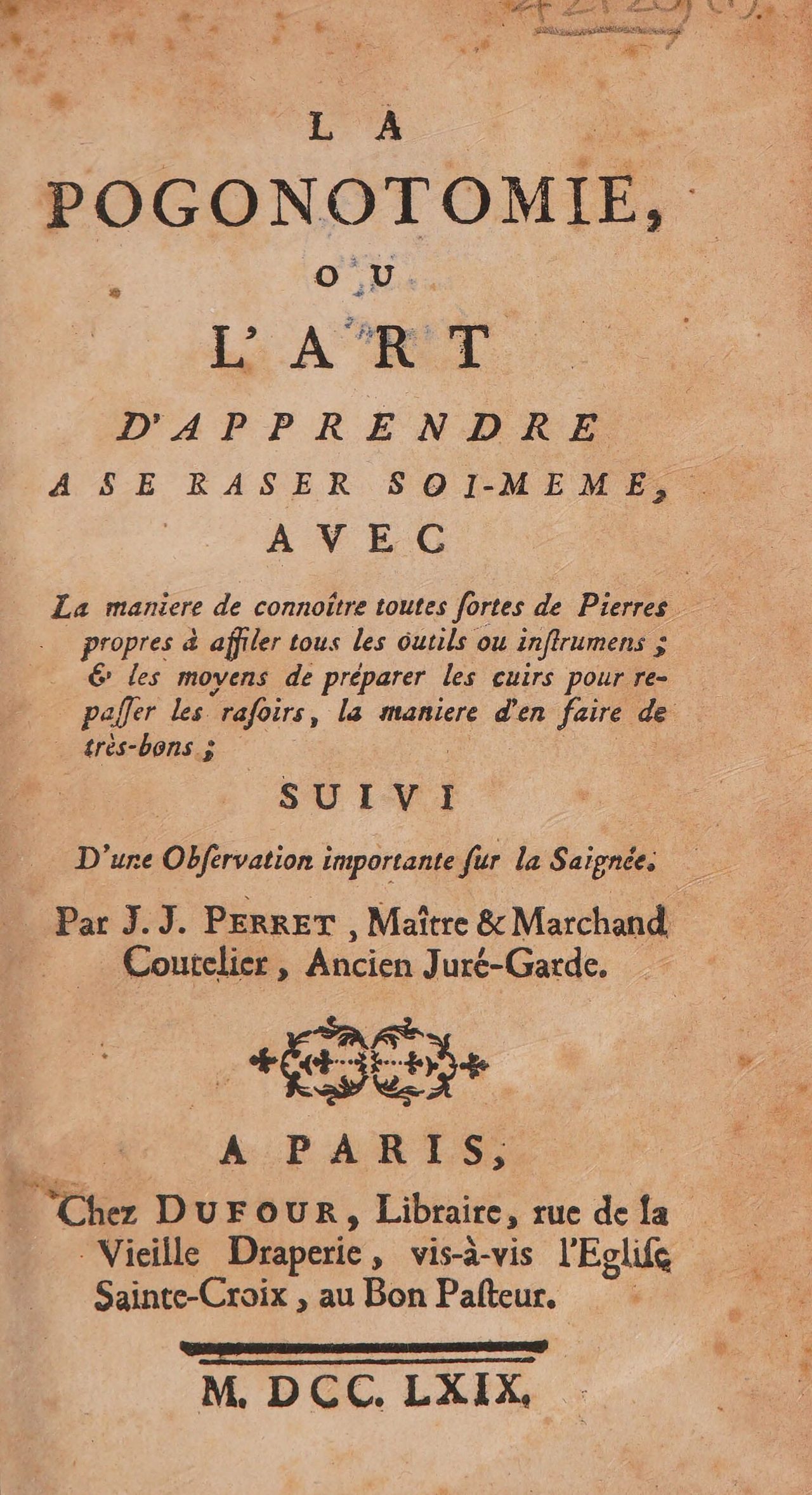
The title page of La Pogonotomie, Paris, Dufour, 1769, naming Perret a master cutler. This copy has no plates, so neither the plane razor nor the wig-head is pictured.
- Image:
- Jean-Jacques Perret, title page of La Pogonotomie (the art of learning to shave yourself), printed book, Paris, 1769. Wellcome Collection. Public Domain Mark.
- Source:
- Jean-Jacques Perret, La Pogonotomie (Paris, 1769), ch. VII, our translation
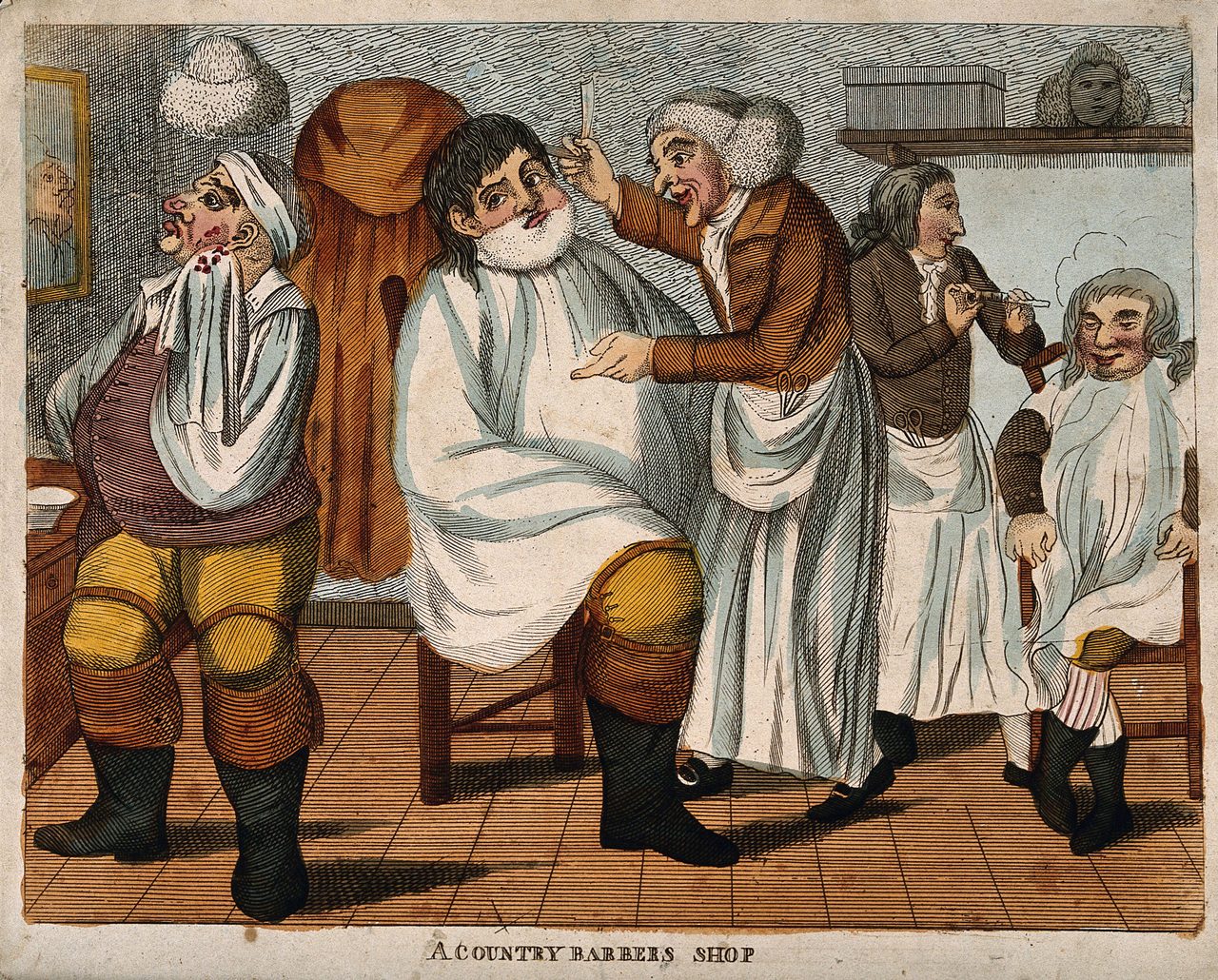
A country barbers shop, a coloured engraving: at the left a farmer stanches a cut on his face. The record gives the print no date.
- Image:
- N. C. Goodnight, A country barbers shop, coloured engraving, undated. Wellcome Collection. Public Domain Mark.
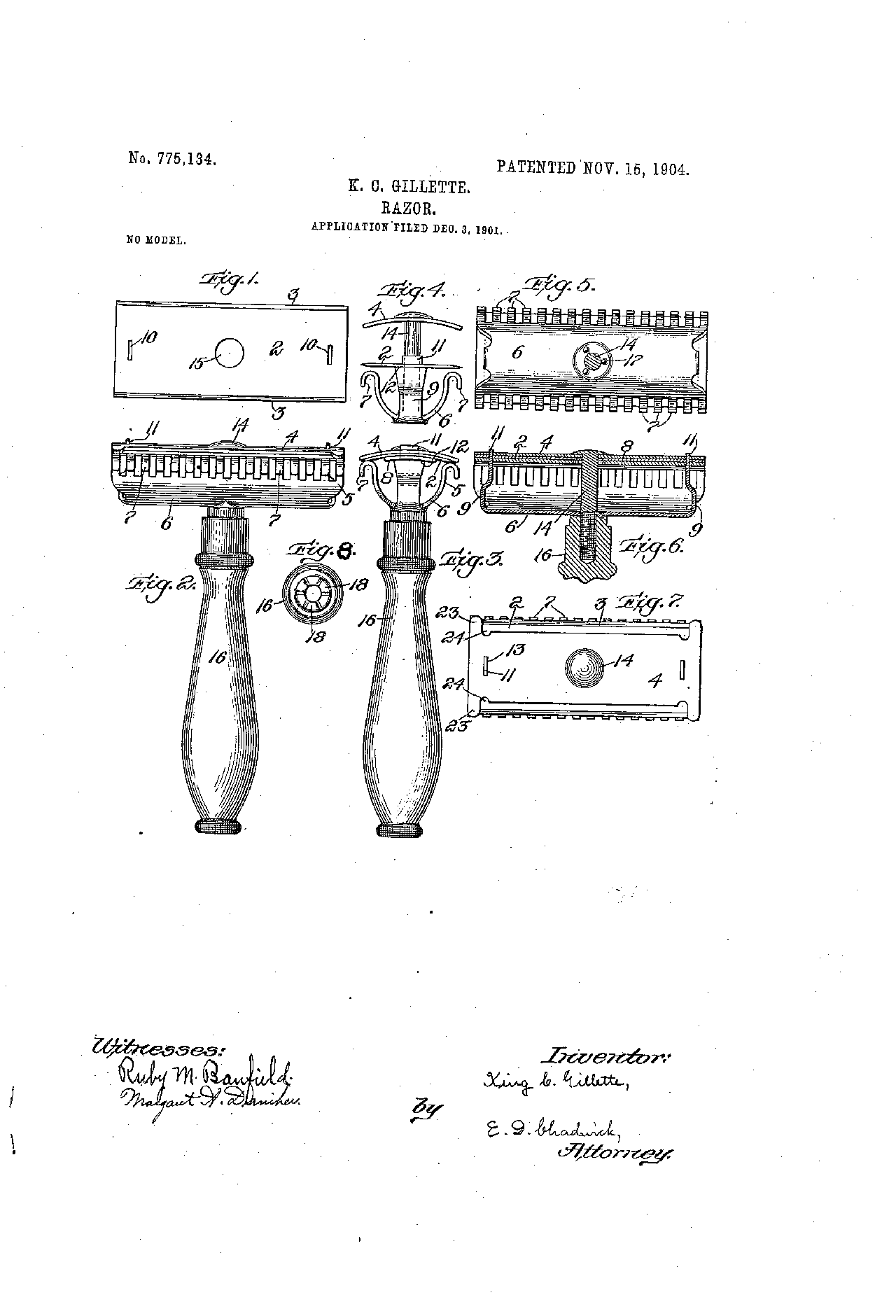
The drawing sheet of US patent 775,134, lettered PATENTED NOV. 15, 1904: eight figures, signed for Gillette by his attorney, E. D. Chadwick.
- Image:
- King C. Gillette, Razor, US Patent 775,134, drawing, 15 November 1904. United States Patent and Trademark Office.
- Source:
- US Patents 775,134 (1904) and 228,904 (1880); Perret, La Pogonotomie (1769), preface, our translation
15 November 1904: a blade to throw away
US patent 775,134, “Razor”, was issued on 15 November 1904 for an invention of King C. Gillette of Brookline, Massachusetts, filed on 3 December 1901; its printed heading names him as assignor to the Federal Trust Company of Boston. It starts from razors “of the safety type”, whose blades “require to be stropped and honed frequently, which cannot be done satisfactorily by the average individual user himself”. Its answer is blades of “very thin sheet-steel”, so cheap “that the user may buy them in quantities and throw them away when dull”, with two edges “so that the life of a blade may thus be doubled”.
Gillette’s own claim is careful: “so far as I am aware, I am the first to produce a razor-blade which may be thrown away when dull without loss of economy and to combine such a blade with a holder adapted to support the blade and also to give its cutting edge the rigidity necessary [...]”. He patented the throwaway blade and the holder that stiffens it.
By a modern company history, production began in 1903; that October the firm was renamed the Gillette Safety Razor Company, and it began advertising the same year. On 8 June 1907 the Star of Christchurch, New Zealand, carried a small advertisement offering a block meerschaum pipe, “bargain or would exchange for new gillette safety razor”. We read the advertisement as the scan’s machine-read text, so it is quoted in lower case as that text gives it.
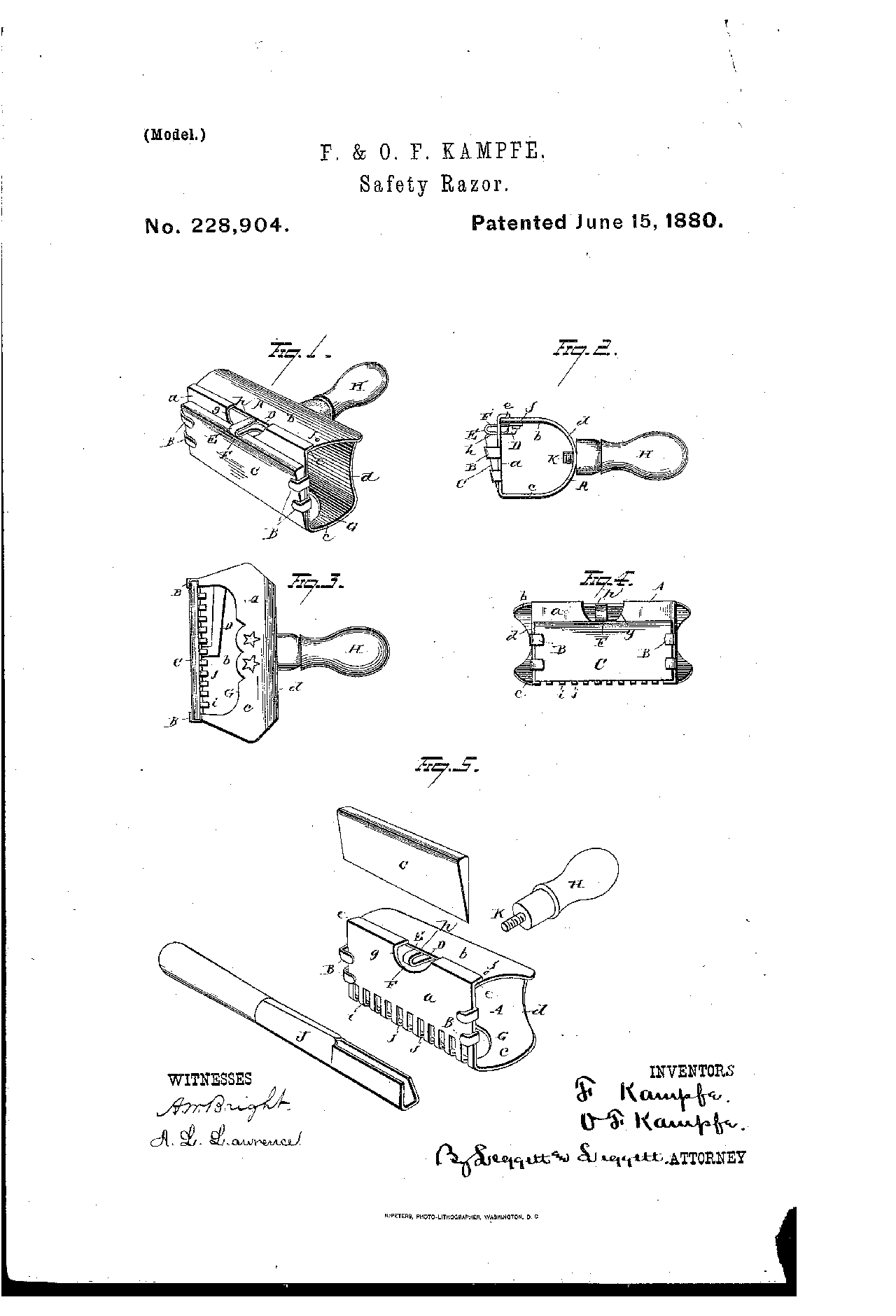
The drawing sheet of US patent 228,904, lettered F. & O. F. Kampfe, Safety Razor, Patented June 15, 1880: five figures. A safety razor of 1880, not offered as the first.
- Image:
- F. and O. F. Kampfe, Safety Razor, US Patent 228,904, drawing, 15 June 1880. United States Patent and Trademark Office.
The stories that don’t hold up
- “Gillette invented the safety razor.”
His patent of 1904 speaks of “razors of the safety type, the use of which as heretofore constructed”, so they were there before it. On 15 June 1880 Frederic and Otto F. Kampfe of New York had patented “Improvements in Safety-Razors”. Their specification says “Our invention relates to an improvement in safety-razors”, and its toothed guard “will yield sufficiently to allow the razor to sever the hair without danger of cutting the skin”. Their blade was still “then honed and strapped”. Perret’s plane razor is older again. One modern company history credits Gillette with “a patent on the safety razor”, which is the loose version.
- “Perret invented the safety razor in 1770.”
He says he invented his plane razor in 1762, and a rival claimed it the same year. The Wellcome Collection’s copy of the book is dated 1769 on its title page, with an approbation of 28 September 1768 and a privilege of 24 May 1769.
- “Egyptians shaved to keep off lice.”
Herodotus gives lice as the reason for the priests alone, who shaved the whole body every other day. Of other Egyptians he says that they “are shaven at other times”, and gives no reason.
- “Alexander had his army shaved so that enemies could not grab their beards.”
The source is Plutarch, about four centuries after Alexander, and Plutarch hedges: “as they say, he ordered his generals to have the beards of their Macedonians shaved, since these afforded the readiest hold in battle” (Theseus 5.4, tr. Bernadotte Perrin, 1914).
- “Romans were always clean-shaven.”
Varro has barbers reaching Italy only about 300 BCE and points at the bearded statues of earlier men. By the Cleveland Museum of Art’s record, beards came back into fashion under Hadrian.
- “The 1645 edict said: keep your hair, lose your head.”
The saying is not in the edicts. They threaten military law and severe punishment, and their harshest line orders death without pardon for anyone who petitions to keep the Ming style. The saying stands beside them. The Haijiao yibian opens its chapter with “Keep your body and lose your hair; keep your hair and lose your body”. Lu Xun’s story “Fengbo”, printed in Xin qingnian in 1920, has “留髮不留頭,留頭不留髮”, “Keep your hair and you don’t keep your head; keep your head and you don’t keep your hair.” (our translation). The speaker in the story pins it on the Taiping years, not on 1645.
- “Native Americans had no beards.”
Catlin wrote that “eighteen out of twenty, by nature are entirely without the appearance of a beard; and of the very few who have them by nature, nineteen out of twenty eradicate it by plucking”. “By nature” is his claim. What his own page describes is plucking: at puberty for most, and nearly every day for a man who missed the moment.
- “Muslims don’t shave.”
It depends which hair. The collection that tells men to let the beard grow full also counts shaving the pubic hair as part of the fitra, and asks God’s mercy first on pilgrims who shave the head.
Sources
- Herodotus, Histories 2.36 and 2.37, tr. A. D. Godley (Loeb Classical Library, 1920): www.perseus.tufts.edu ; www.perseus.tufts.edu.
- Genesis 41:14, The Holy Scriptures According to the Masoretic Text (Jewish Publication Society, 1917), the English ; the Hebrew.
- W. C. Hayes, The Scepter of Egypt II (Metropolitan Museum of Art, 1959).
- Varro, De re rustica 2.11.10, Latin ed. W. D. Hooper and H. B. Ash (Loeb, 1934), p. 418.
- Pliny the Elder, Natural History 7.59, tr. John Bostock and H. T. Riley (Bohn’s Classical Library, 1855).
- Aulus Gellius, Attic Nights 3.4.1 to 3, tr. J. C. Rolfe (Loeb Classical Library, 1927), vol. 1, p. 253.
- Martial, Epigrams 7.83, tr. anonymous (1695), as printed in Bohn’s Classical Library.
- Suetonius, Nero 12.4, tr. J. C. Rolfe (Loeb Classical Library, 1914).
- Historia Augusta, Life of Hadrian 26.1, Latin text.
- Cleveland Museum of Art, record text for Head of a Bearded Man, 1924.535.
- Cullavagga V.27 and VII.1.4, Vinaya Texts III, tr. T. W. Rhys Davids and Hermann Oldenberg, Sacred Books of the East 20 (Oxford, 1885), pp. 137 to 139 and 229 to 230.
- The Kama Sutra, Part I, ch. IV, Kama Shastra Society English of 1883.
- Cleveland Museum of Art, record text for Barber Cleaning a Woman’s Ear, 2003.117.
- Sahih al-Bukhari 5891, 5892 and 1727, Arabic text: sunnah.com ; sunnah.com ; sunnah.com.
- Qur’an 48:27, tr. Marmaduke Pickthall, The Meaning of the Glorious Koran (New York, Knopf, 1930), p. 531.
- Miura Jōshin, Keichō kenmonshū (1614), book 4, in Zasshi shū (Kokumin Bunko, 1912), pp. 568 to 569 ; the scan.
- Cleveland Museum of Art, record text for Suzuki Harunobu, Benevolence, 1949.124.
- Wellcome Collection, record of a photograph of Japanese barbers, 35505i (the note on its back).
- Qing shilu, Shizu shilu, juan 5 (1644) and juan 17 (1645): 清實錄 世祖章皇帝實錄 卷五 ; 清實錄 世祖章皇帝實錄 卷十七.
- Haijiao yibian, chapter 57.
- Huangchao tongdian (Siku quanshu edition), juan 62.
- Zhou Pei Qun, inscription on the watercolour, Wellcome Collection 571507i.
- Lu Xun, “Fengbo”, first printed in Xin qingnian 8.1 (1 September 1920); the text read is a 1948 printing of Lu Xun quanji, vol. 1, on Wikisource.
- Hernán Cortés, Second Letter (1520), Letters of Cortes, tr. Francis Augustus MacNutt (New York and London, 1908), vol. 1, pp. 210 and 257 to 258.
- George Catlin, Letters and Notes on the Manners, Customs, and Condition of the North American Indians, vol. 2 (London, 1841), p. 227.
- Jean-Jacques Perret, La Pogonotomie, ou l’art d’apprendre à se raser soi-même (Paris, Dufour, 1769), preface pp. vi and x to xii, ch. VII pp. 100 and 106 to 108.
- King C. Gillette, US patent 775,134, “Razor”, 15 November 1904.
- Frederic and Otto F. Kampfe, US patent 228,904, “Improvements in Safety-Razors”, 15 June 1880.
- The Gillette Company history on encyclopedia.com.
- Star (Christchurch), 8 June 1907, p. 6, advertisements, column 5, via DigitalNZ.
- Plutarch, Theseus 5.4, tr. Bernadotte Perrin (Loeb Classical Library, 1914).
Images
- Razor belonging to Hatnefer, bronze or copper alloy and boxwood, Egypt, ca. 1491 to 1473 BCE. The Metropolitan Museum of Art, 36.3.69. Held by The Metropolitan Museum of Art, New York, Open Access.
- Ruiu’s razor, bronze or copper alloy, Egypt, ca. 1504 to 1447 BCE. The Metropolitan Museum of Art, 35.3.55. Held by The Metropolitan Museum of Art, New York, Open Access.
- Head of a bearded man, marble, Roman, c. 125 CE. The Cleveland Museum of Art, 1924.535. Held by The Cleveland Museum of Art, CC0.
- A painter from Tanjore, a barber shaving a man’s head, gouache, ca. 1840. Wellcome Collection. Public Domain Mark. Held by Wellcome Collection, London, 32924i.
- Barber cleaning a woman’s ear, gum tempera, ink and tin on paper, Kalighat, Kolkata, c. 1890. The Cleveland Museum of Art, 2003.117. Held by The Cleveland Museum of Art, CC0.
- Anonymous, a barber shaving a man’s head, Algiers, albumen print, 1851 to 1900. Rijksmuseum, RP-F-00-12305. Held by Rijksmuseum, Amsterdam, Public Domain Mark.
- Suzuki Harunobu, Benevolence, from The Five Virtues, colour woodblock print, 1767. The Cleveland Museum of Art, 1949.124. Held by The Cleveland Museum of Art, CC0.
- Zhou Pei Qun, a street barber shaving a man’s head in the Manchu style, watercolour, ca. 1890. Wellcome Collection. Public Domain Mark. Held by Wellcome Collection, London, 571507i.
- Jean-Jacques Perret, title page of La Pogonotomie (the art of learning to shave yourself), printed book, Paris, 1769. Wellcome Collection. Public Domain Mark. Held by Wellcome Collection, London.
- N. C. Goodnight, A country barbers shop, coloured engraving, undated. Wellcome Collection. Public Domain Mark. Held by Wellcome Collection, London, 30012i.
- King C. Gillette, Razor, US Patent 775,134, drawing, 15 November 1904. United States Patent and Trademark Office. Held by United States Patent and Trademark Office, public domain as a US patent of 1904.
- F. and O. F. Kampfe, Safety Razor, US Patent 228,904, drawing, 15 June 1880. United States Patent and Trademark Office. Held by United States Patent and Trademark Office, public domain as a US patent of 1880.
We found no open image of people shaving or plucking in the Americas in the collections we searched (the Wellcome Collection and the Cleveland Museum of Art among them), so that section is text only. We found no open image of the wooden pincers Miura describes, and no Roman razor; the Harunobu print and the marble head are captioned as what they are. The Wellcome Collection’s copy of Perret has no plates. The Kalighat painting and the Kampfe drawing appear on this page only.