No. 1 · Edited by Alex Vita
Living beforeglasses
One pair of glasses cost a good horse
The second pair a Ming writer saw. The first was an emperor’s gift.
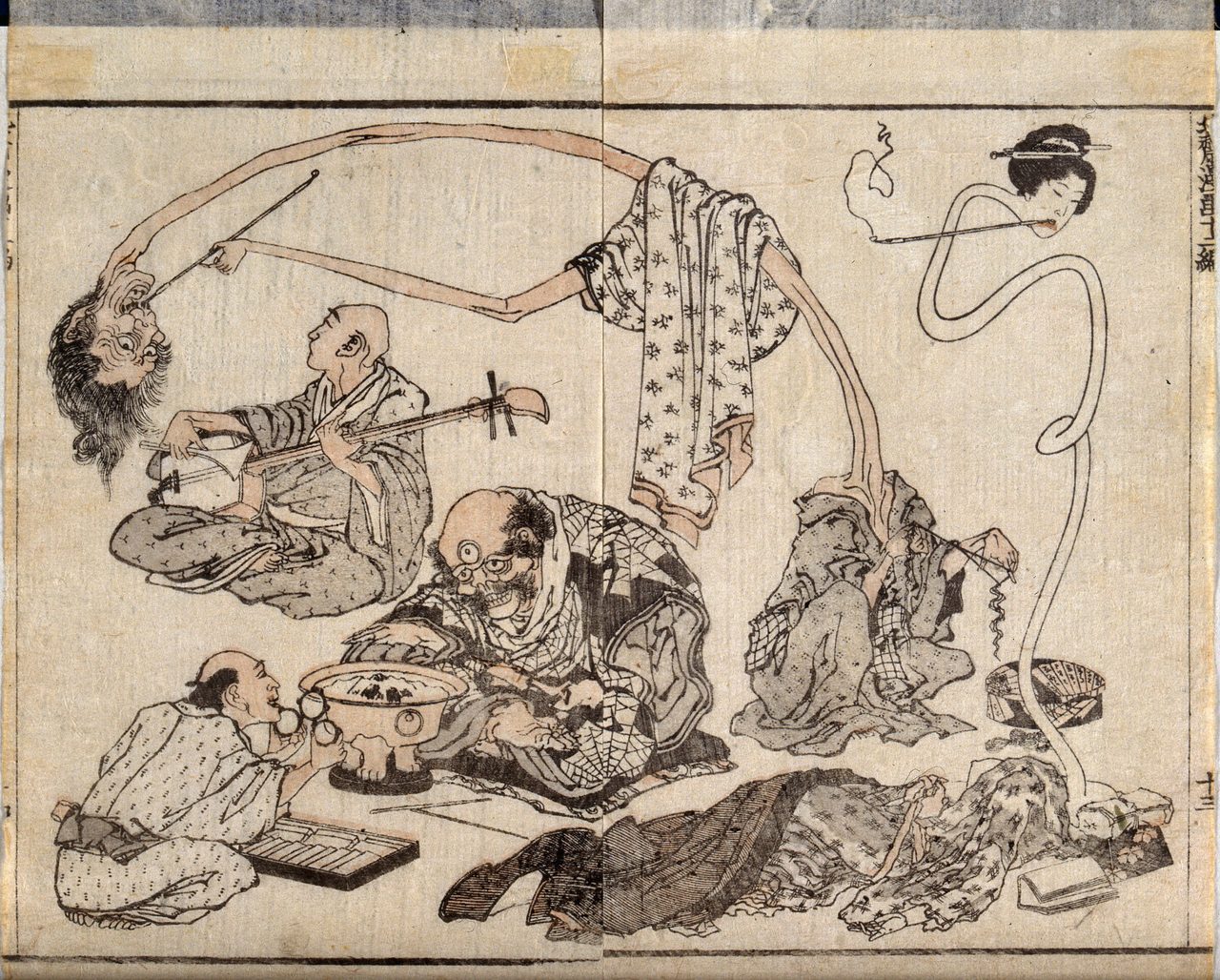
Not history, a joke. A three-eyed man is fitted for glasses in a Hokusai print of 1834.
- Image:
- Katsushika Hokusai, a man with three eyes fitted with spectacles, coloured woodcut, 1834. Wellcome Collection. Public Domain Mark.
- Source:
- Zhang Ning, Fangzhou za lu (Ming), via Gujin tushu jicheng (1726), our translation; National Eye Institute; Baldanzi and Farini 2024
Somewhere between 40 and 55 the small print drifts out of reach, and by the mid-50s it has happened to everyone. Glasses have no inventor anyone can name, but they have a date: a Wednesday in Florence in 1306, when a preacher called them “not yet twenty years” old. What 4 societies knew or did about failing eyes, with the original beside our English wherever we quote.
That morning was 1305 by the Florentine calendar.
Rome, 1st century: water, and an emerald
Seneca, in the Natural Questions:
“Everything looks far larger to anyone who sees it through water: letters, however small and faint, look larger and clearer through a glass ball full of water.”
Seneca, Natural Questions 1.6.5. Our translation.
omnia per aquam uidentibus longe esse maiora: litterae quamuis minutae et obscurae per uitream pilam aqua plenam maiores clarioresque cernuntur
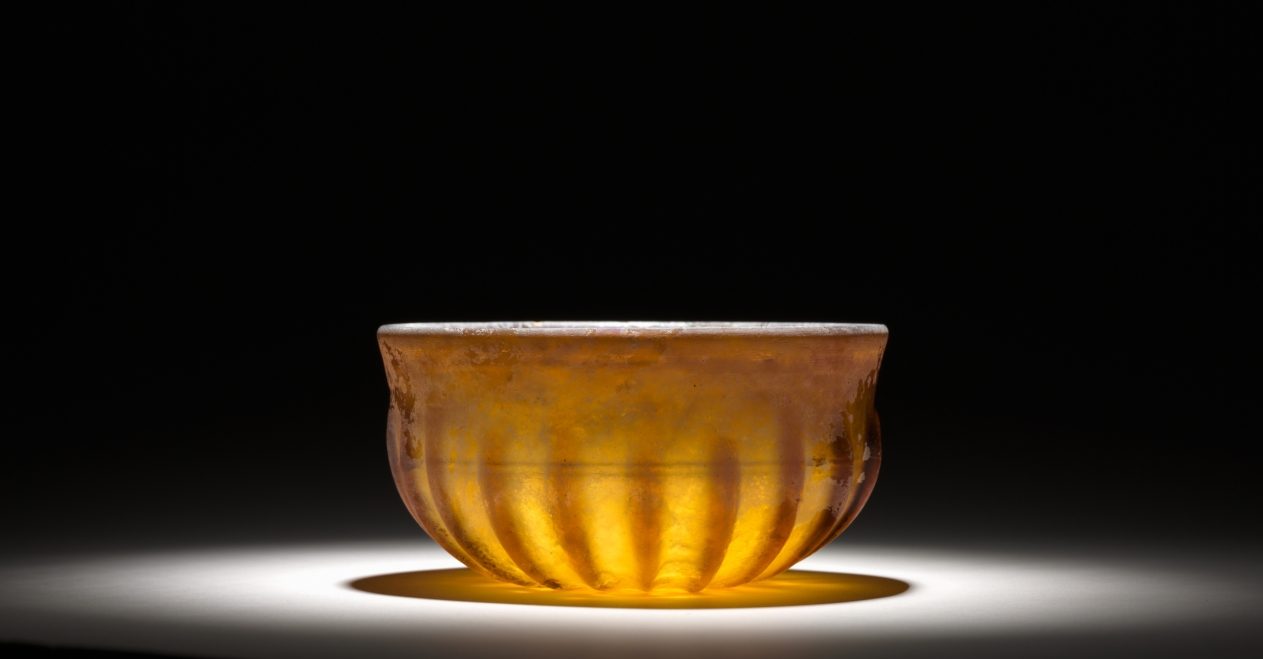
Roman glass of Seneca’s century, a ribbed bowl of 1 to 100 CE. Not his ball.
- Image:
- Ribbed glass bowl, Roman, 1 to 100 CE. The Cleveland Museum of Art, Gift of Dr. Norman Zaworski, 2009.474.
- Source:
- Seneca, Natural Questions 1.6.5; Pliny, Natural History 37.64. Our translations
He credits the water, not the glass, and no glasses came of it.
Pliny the Elder says flat emeralds reflect like mirrors, then: “Nero princeps gladiatorum pugnas spectabat in smaragdo”, the emperor Nero used to watch the gladiators fight in an emerald (Natural History 37.64, our translation). He never says how or why. Elsewhere Pliny calls Nero’s eyes weak unless he narrowed them (Natural History 11.144), but he never connects that to the emerald; the eyeglass story does.
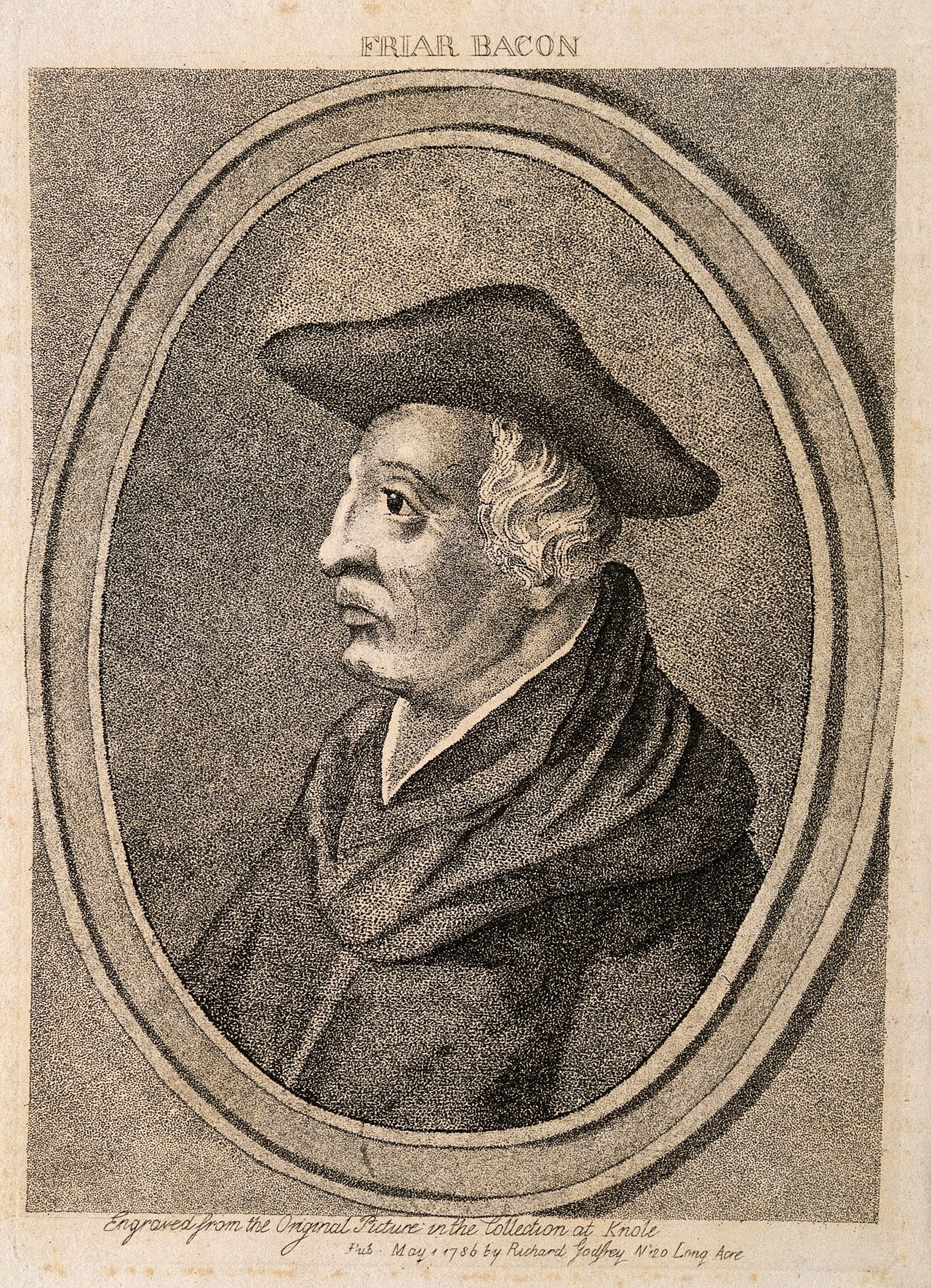
Friar Bacon in a 1786 engraving after a painting at Knole, made about five centuries after his death.
- Image:
- Friar Bacon, stipple engraving after a painting at Knole, 1786. Wellcome Collection. Public Domain Mark.
- Source:
- Roger Bacon, Opus Majus, Perspectiva 3.2 (Bridges 1897), our translation; Venice ordinance of 2 April 1300, via Baldanzi and Farini 2024
Europe, 1260s to 1300: the reading stone
Roger Bacon, in the 1260s, describes glass placed on the letters, the smaller part of a sphere with its curve toward the eye: “longe melius videbit literas et apparebunt ei majores”, he will see the letters far better, and they will look larger to him. And: “hoc instrumentum est utile senibus et habentibus oculos debiles”, this instrument is useful to the old and to those with weak eyes (Opus Majus, Perspectiva 3.2, ed. Bridges 1897, vol. 2 p. 157; our translation).
Bacon is not proof that anyone owned such a glass. The evidence that such glasses were made and sold is a Venetian glassmakers’ rule of 2 April 1300 against passing off ordinary glass as crystal in roidi da ogli, “discs for the eyes”, and lapides ad legendum, “stones for reading”: one of the earliest dated documents to name either.
Florence, Wednesday 23 February 1306
That morning (1305 by the Florentine calendar) Giordano da Pisa preached at Santa Maria Novella, and someone wrote down what he said:
“It is not yet twenty years since the art of making spectacles was found, spectacles that make you see well. It is one of the best and most necessary arts the world has, and it was found so recently: a new art that never was before. And the lector said: I saw the man who first found it and made it, and I talked with him.”
Giordano da Pisa, 23 February 1306, ed. Narducci 1857. Our translation.
Non è ancora XX anni che si trovò l'arte di fare gli occhiali, che fanno vedere bene, ch'è una delle migliori arti e delle più necessarie che 'l mondo abbia, ed è così poco che si trovò: arte novella che mai non fu. E disse il lettore: Io vidi colui che prima la trovò e fece, e favellaigli.
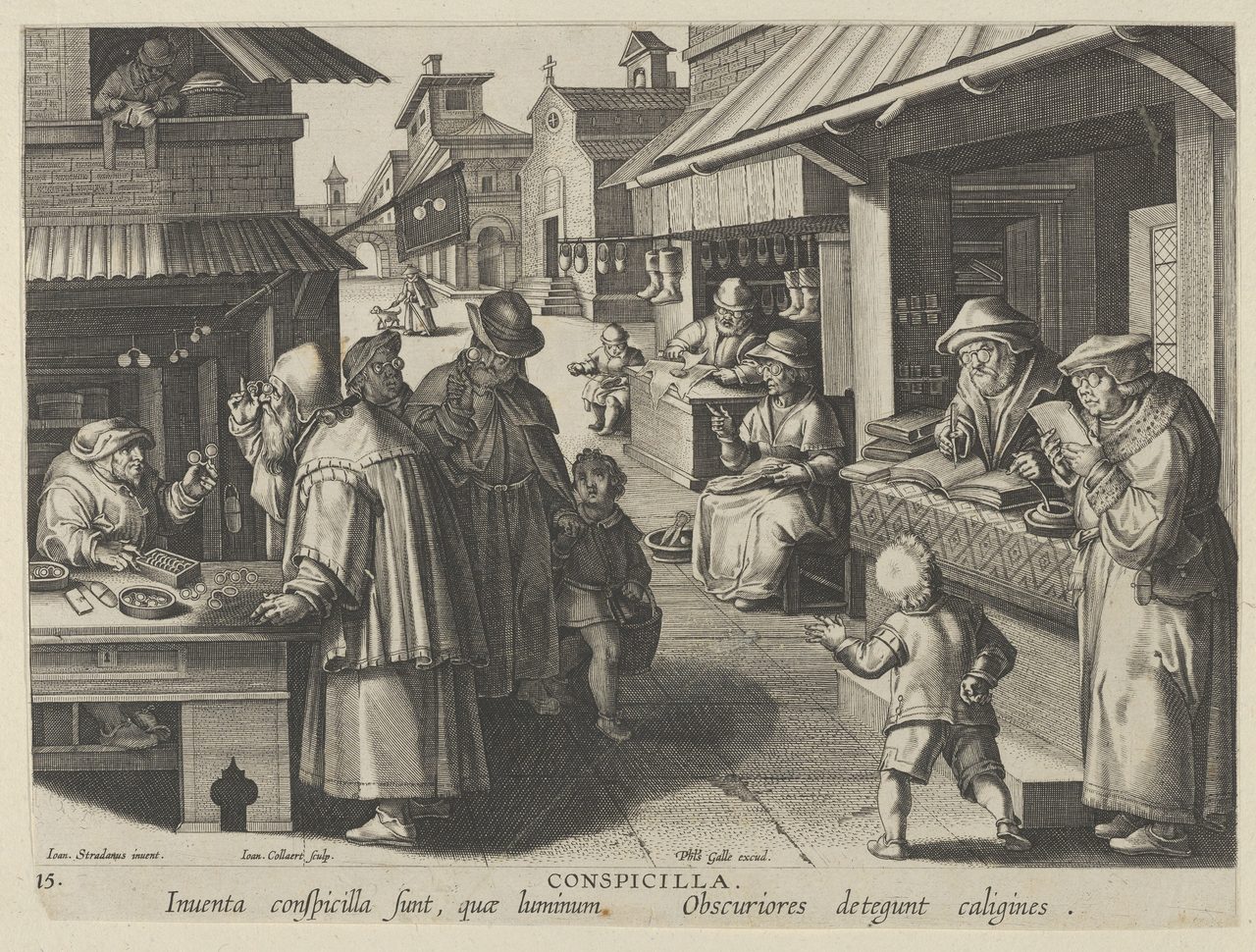
A spectacle shop as Stradanus drew it around 1600, three centuries after the sermon.
- Image:
- Jan Collaert I after Stradanus, The Invention of Eyeglasses (Nova Reperta, pl. 15), ca. 1600. The Metropolitan Museum of Art, 49.95.870(6).
- Source:
- Giordano da Pisa, sermon at Santa Maria Novella, 23 Feb 1306 (Narducci 1857), our translation
“The lector” is Giordano himself, his teaching title; the transcript is a listener’s record, so he appears in the third person. Taken at his word, that puts the first pair after 1286, most likely in northern Italy.
A Pisa chronicle gets one step closer, still nameless. Of Brother Alessandro della Spina (died 1312) the chronicle of Santa Caterina says: “Ocularia, ab aliquo primo facta, et comunicare nolente, ipse fecit et comunicavit, corde ylari et volente”, spectacles, first made by someone who would not share them, he made himself and shared, with a cheerful and willing heart (Narducci 1857, p. 23; our translation).
China: the emperor’s gift, and a pair bought with a horse
The Ming word, aidai, is probably a loanword from Arabic al-ʿuwaynāt, “little eyes”, or Persian ʿaynak (Heroldová 2019). The best early account is Zhang Ning’s Fangzhou za lu, quoted in the 1726 Gujin tushu jicheng:
“Once, in the capital, at the lodging of Commander Hu Long, I saw two things his father, the Minister of Rites, had been given by the Xuande emperor. They were the size of coins, in shape and colour very like mica, like the glass of our day but very thin. They were rimmed in gold, the gold drawn out into a handle, joined at the end; folded, they were one, opened, two, like the little case of a shop scale. When an old man’s eyes have dimmed and he cannot make out small characters, he opens them out over both eyes, and the characters become clear and twice as large. Lately, at Councillor Sun Jingzhang’s, I saw another pair and tried them: the same again. Jingzhang said: ‘I got them in exchange for a good horse, from a foreign merchant of the Western Regions.’ I seem to have heard them called aidai.”
Zhang Ning, Fangzhou za lu, via the Gujin tushu jicheng, 1726. Punctuation and translation ours.
予向在京時,嘗與指揮胡豅寓所見其父宗伯公所得宣廟賜物如錢大者二,形色絕似雲母石,類世之硝子而質甚薄,以金相輪廓而衍之,為柄紐制其末,合則為一,岐則為二,如市肆中等子匣,老人目昏,不辨細字,張此物于雙目,字明大加倍。近者又于孫景章參政所再見一具,試之復然。景章云:「以良馬易得于西域賈胡滿剌。」似聞其名為僾逮。
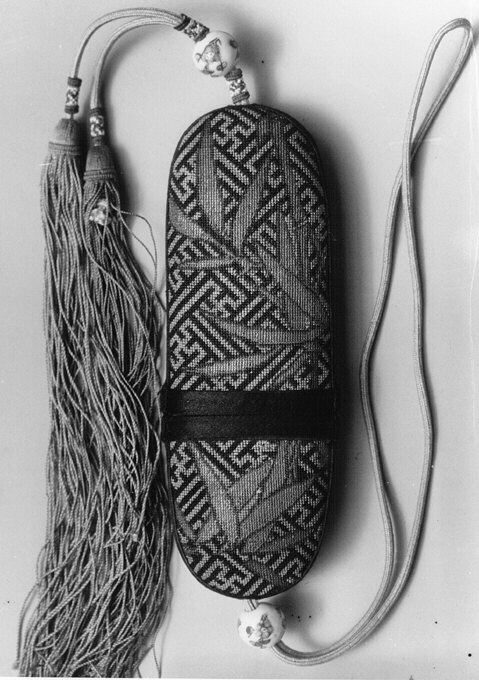
An embroidered eyeglasses case, China, Qing dynasty, 18th to 19th century.
- Image:
- Eyeglasses case with bamboo on fretwork background, China, Qing dynasty, 18th to 19th century. The Metropolitan Museum of Art, 30.75.691.
- Source:
- Zhang Ning, Fangzhou za lu, via Gujin tushu jicheng (1726), our translation
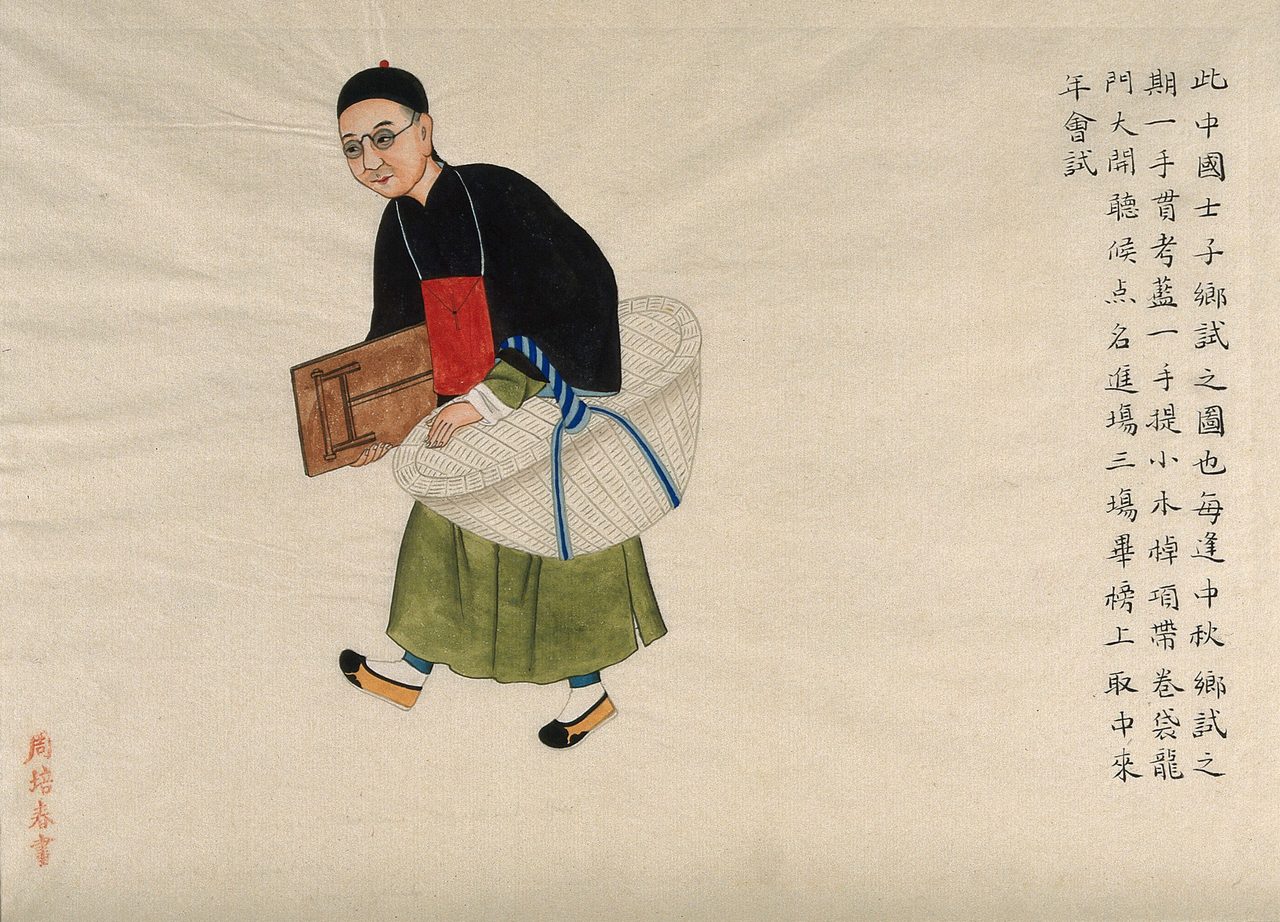
A Qing scholar in round spectacles on his way to the provincial examinations, with his folding table and exam basket, painted about 1890.
- Image:
- Zhou Pei Qun, a scholar on his way to the examinations, watercolour, ca. 1890. Wellcome Collection. Public Domain Mark.
- Source:
- Zhang Ning, Fangzhou za lu, via Gujin tushu jicheng (1726), our translation
The Xuande emperor reigned in the 1420s and 1430s, so spectacles were in China by 1435 at the latest, within 130 years of the Florence sermon. 滿剌 Manla, the last two characters of Sun’s sentence, can be the merchant’s name, a title (mullah) or Malacca, so they stay off the English.
The name that stuck was yanjing, eye-mirror, from the 16th century. By the 17th century the booklet of a lens-maker, Sun Yunqiu, advertised that each customer’s sight was measured and the lenses made to fit (Chen 2018, via Heroldová). In late Qing China a pair might be tied on with a silk ribbon, it was rude to look at a new acquaintance through spectacles, and officials took them off at court (Laufer 1907 and Bock 1903, via Heroldová).
Spectacles were in Syria in the 1300s, most likely through Italian traders (Mazor and Abbou Hershkovits 2013), and India by the late 15th or early 16th century (Agarwal 1971, via Heroldová).
Japan, 1593 onward
Tokugawa Ieyasu owned tortoiseshell glasses late in life, probably imported. A Kyoto court noble wrote in his diary that Ieyasu gave him a pair in 1593 (Japan Tourism Agency, Kunōzan Tōshōgū). By 1791 a woodcut from Osaka could show a fisherman in spectacles (Shunchōsai): one man in one print, but a thing a printmaker could draw by then.
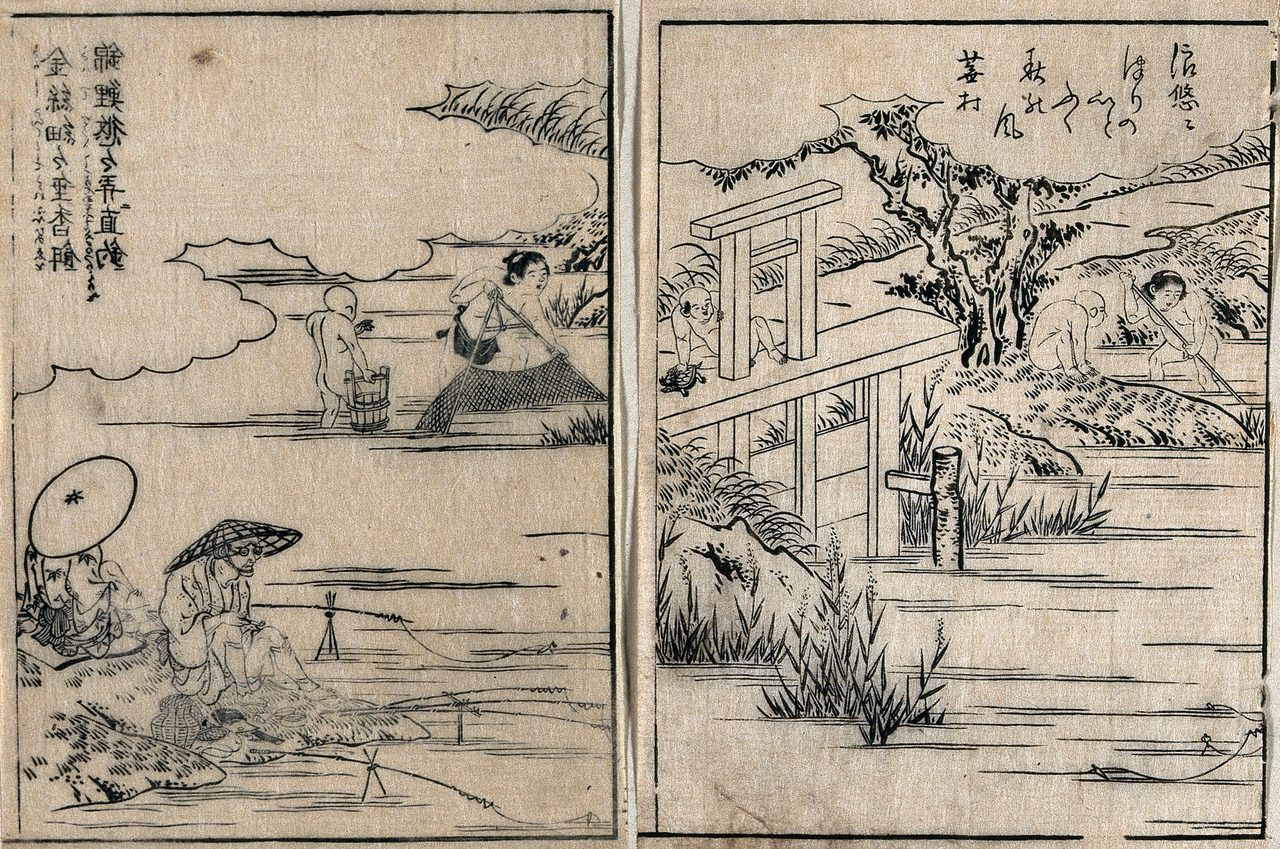
Fishermen on a riverbank, one in spectacles, lower left. Osaka, 1791.
- Image:
- Shunchōsai, fishermen on a riverbank, one in spectacles, woodcut, 1791. Wellcome Collection. Public Domain Mark.
- Source:
- Japan Tourism Agency text for Kunōzan Tōshōgū (2021); Wellcome record 565410i
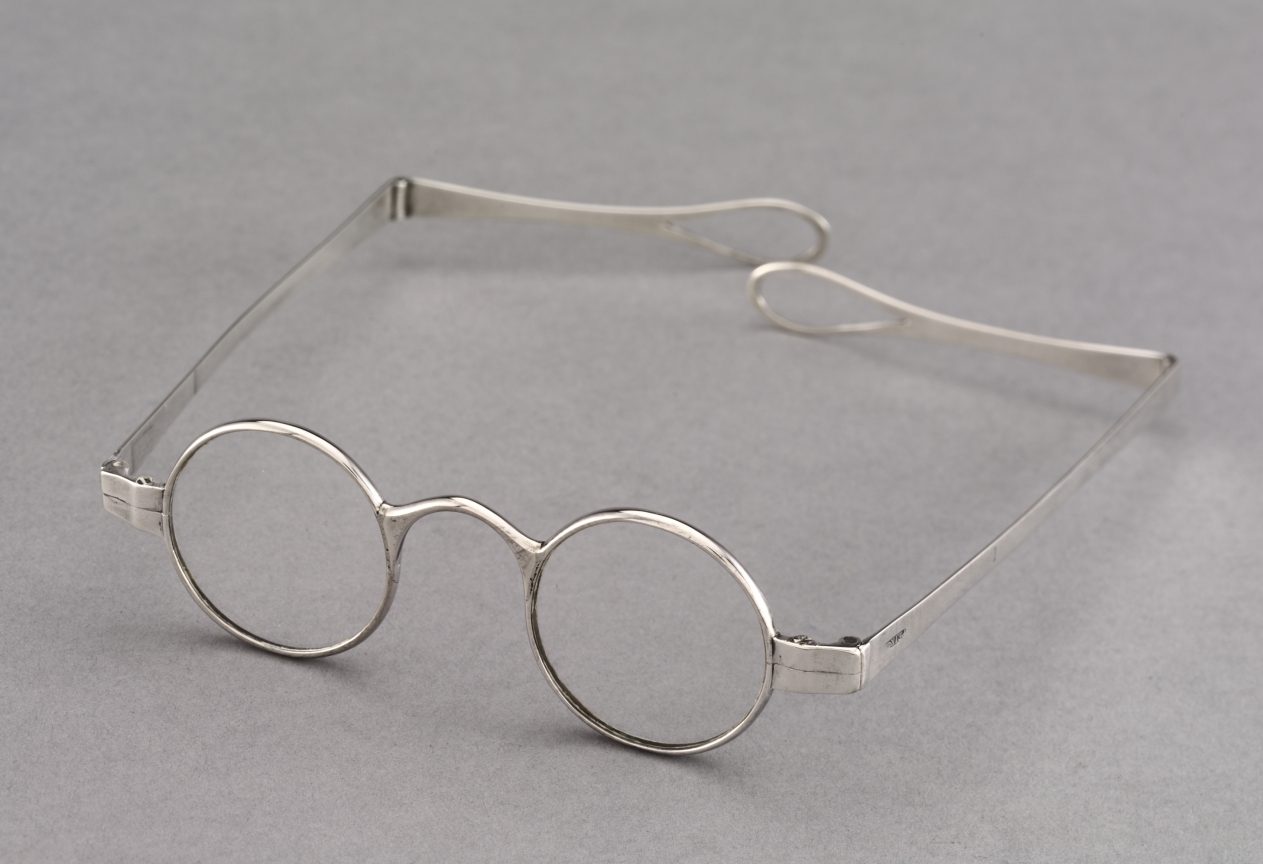
Where it was heading: silver spectacles with side arms by John Peirce, Boston, about 1816 to 1820.
- Image:
- John Peirce, spectacles, silver, Boston, c. 1816 to 1820. The Cleveland Museum of Art, Gift of Hollis French, 1940.246.
- Source:
- Vincent Ilardi’s archive research, via Baldanzi and Farini 2024
After 1306: a trade
In October 1462 Duke Francesco Sforza of Milan ordered 3 dozen pairs from Florence, including the first documented lenses for the short-sighted; in 1466 Galeazzo Maria Sforza ordered reading pairs graded by age. By one estimate, 6 spectacle-makers in Florence in 1525 turned out at least 42,000 pairs a year, in a city of about 60,000 (Ilardi, via Baldanzi and Farini 2024).
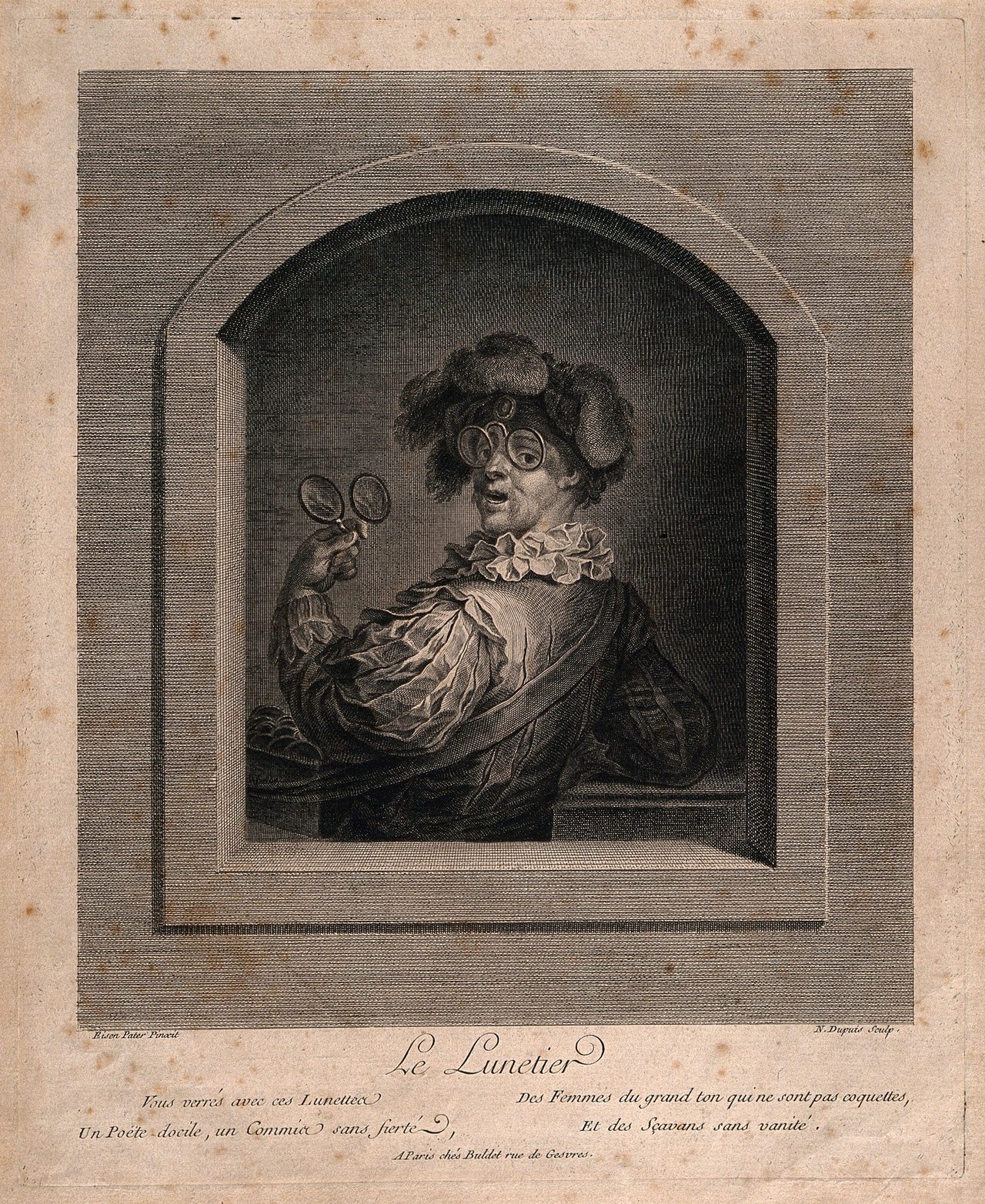
Le Lunetier, a Paris spectacle seller, 18th century.
- Image:
- N. Dupuis after F. Eisen, Le Lunetier (a seller of spectacles), line engraving, 18th century. Wellcome Collection. Public Domain Mark.
- Source:
- Baldanzi and Farini, Il Colle di Galileo 13.2 (2024), after Del Lungo 1920
The stories that don’t hold up
- “Salvino degli Armati invented spectacles.”
In 1684 Leopoldo Del Migliore named a Florentine, Salvino degli Armati, and quoted an epitaph nobody has found. Around 1841 a tomb for him appeared in the cloister of Santa Maria Maggiore, built from an ancient bust, another man’s statue and a sarcophagus dated 1272, before spectacles existed. In 1885 Pasquale Villari composed a plaque for a house on Chiasso degli Armati, and a school took his name.
Isidoro Del Lungo exposed it in 1920 (Baldanzi and Farini 2024). The documented Salvino never dealt with glasses. On 30 July 2023 one of the article’s two authors asked ChatGPT who invented glasses and got Salvino, called a monk; by the time the article appeared, they report, the answer had been corrected.
- “Alessandro della Spina invented them.”
His convent’s chronicle says someone else made them first (above).
- “Nero had an emerald eyeglass.”
Pliny mentions Nero’s weak eyes in one book and the emerald in another, and never links them (above).
- “China had spectacles in the Song dynasty.”
The Kangxi Dictionary (1716) quotes a line on aidai from the Dongtian qinglu, a Song book of the 1240s. The line is missing from all 3 transmitted texts we checked; later editions of Song books carry additions.
- “Malacca made them.”
The Ming texts say aidai “come from” Manla, a claim of origin; they cannot settle where the lenses were ground.
- “The Treviso fresco shows the first wearer.”
Tommaso da Modena’s 1352 frescoes at San Nicolò, Treviso, show 3 Dominicans with spectacles, a hand lens and a lens on a stand (Daxecker 1999): painted in 1352, it shows how a painter pictured scholars then, not who wore spectacles first.
Sources
- Seneca, Naturales Quaestiones 1.6.5. Latin text at The Latin Library.
- Pliny the Elder, Naturalis Historia 37.64, ed. Mayhoff. Perseus Digital Library Latin texts, file phi0978.phi001.perseus-lat2.xml.
- Roger Bacon, Opus Majus, Perspectiva, part 3, dist. 2. Latin ed. J. H. Bridges, Oxford 1897, vol. 2 p. 157.
- Venetian ordinance of 2 April 1300, as cited by L. Baldanzi and P. Farini, Il Colle di Galileo 13.2 (2024), CC BY 4.0, after Del Vecchio (1999) (PDF). The same article is the source for the Salvino degli Armati story (after Del Lungo 1920), the Sforza orders of 1462 and 1466 and the 1525 estimate (after Vincent Ilardi), and the ChatGPT test of 30 July 2023.
- F. Daxecker, Documenta Ophthalmologica 99 (1999), p. 219, abstract.
- Giordano da Pisa, sermon of 23 February 1305 (Florentine style; 1306), Santa Maria Novella, in F. Narducci’s edition, Florence 1857, pp. 22 to 23 and Predica IV.
- Chronicle of Santa Caterina, Pisa, on Alessandro della Spina, Latin as printed by Narducci 1857, p. 23 (same volume).
- Zhang Ning, Fangzhou za lu, as quoted in the Gujin tushu jicheng (1726), Renshi dian ch. 12. Shorter version in Yuan Ming shilei chao ch. 28.
- Zhang Xie, Dongxi yang kao, ch. 4 (the Ming text behind the Malacca myth; it quotes the Hua yi kao).
- Kangxi Dictionary, entry 靉. Dongtian qinglu texts checked: 洞天清錄 ; 洞天清録 (四庫全書本) ; 説郛 (四庫全書本) 卷095.
- H. Heroldová, Annals of the Náprstek Museum 40.1 (2019), doi 10.2478/anpm-2019-0007 (for the aidai loanword, yanjing, Sun Yunqiu after Chen 2018, the silk ribbon after Bock 1903 and Laufer 1907, the etiquette after Laufer 1907, and India after Agarwal 1971)
- A. Mazor and K. Abbou Hershkovits, “Spectacles in the Muslim World”, Early Science and Medicine 18.3 (2013), 291 to 305, abstract.
- Japan Tourism Agency, multilingual text for Kunōzan Tōshōgū (2021).
- Presbyopia: National Eye Institute, Presbyopia (everyone gets it, usually after age 45); and Baldanzi and Farini 2024, p. 36, citing Glasser and Campbell 1998 (it affects all people over 50 to 55; same article as above).
Images
- Katsushika Hokusai, a man with three eyes fitted with spectacles, coloured woodcut, 1834. Wellcome Collection. Public Domain Mark. Held by Wellcome Collection, London, 565230i.
- Ribbed glass bowl, Roman, 1 to 100 CE. The Cleveland Museum of Art, Gift of Dr. Norman Zaworski, 2009.474. Held by The Cleveland Museum of Art, CC0.
- Friar Bacon, stipple engraving after a painting at Knole, 1786. Wellcome Collection. Public Domain Mark. Held by Wellcome Collection, London.
- Jan Collaert I after Stradanus, The Invention of Eyeglasses (Nova Reperta, pl. 15), ca. 1600. The Metropolitan Museum of Art, 49.95.870(6). Held by The Metropolitan Museum of Art, New York, Open Access.
- Zhou Pei Qun, a scholar on his way to the examinations, watercolour, ca. 1890. Wellcome Collection. Public Domain Mark. Held by Wellcome Collection, London, 571457i.
- Eyeglasses case with bamboo on fretwork background, China, Qing dynasty, 18th to 19th century. The Metropolitan Museum of Art, 30.75.691. Held by The Metropolitan Museum of Art, New York, Open Access.
- Shunchōsai, fishermen on a riverbank, one in spectacles, woodcut, 1791. Wellcome Collection. Public Domain Mark. Held by Wellcome Collection, London, 565410i.
- John Peirce, spectacles, silver, Boston, c. 1816 to 1820. The Cleveland Museum of Art, Gift of Hollis French, 1940.246. Held by The Cleveland Museum of Art, CC0.
- N. Dupuis after F. Eisen, Le Lunetier (a seller of spectacles), line engraving, 18th century. Wellcome Collection. Public Domain Mark. Held by Wellcome Collection, London, 16259i.
We found no open-licence image of spectacles in the Islamic world in the 5 collections we searched (Met, Cleveland, Wellcome, Art Institute of Chicago, Rijksmuseum), so the Syria and India lines have no picture.