No. 3 · Edited by Alex Vita
Living beforealarm clocks
The dawn call came with the weather
Called along Hangzhou’s streets, 1270s. If it rained, the call was: Rain.
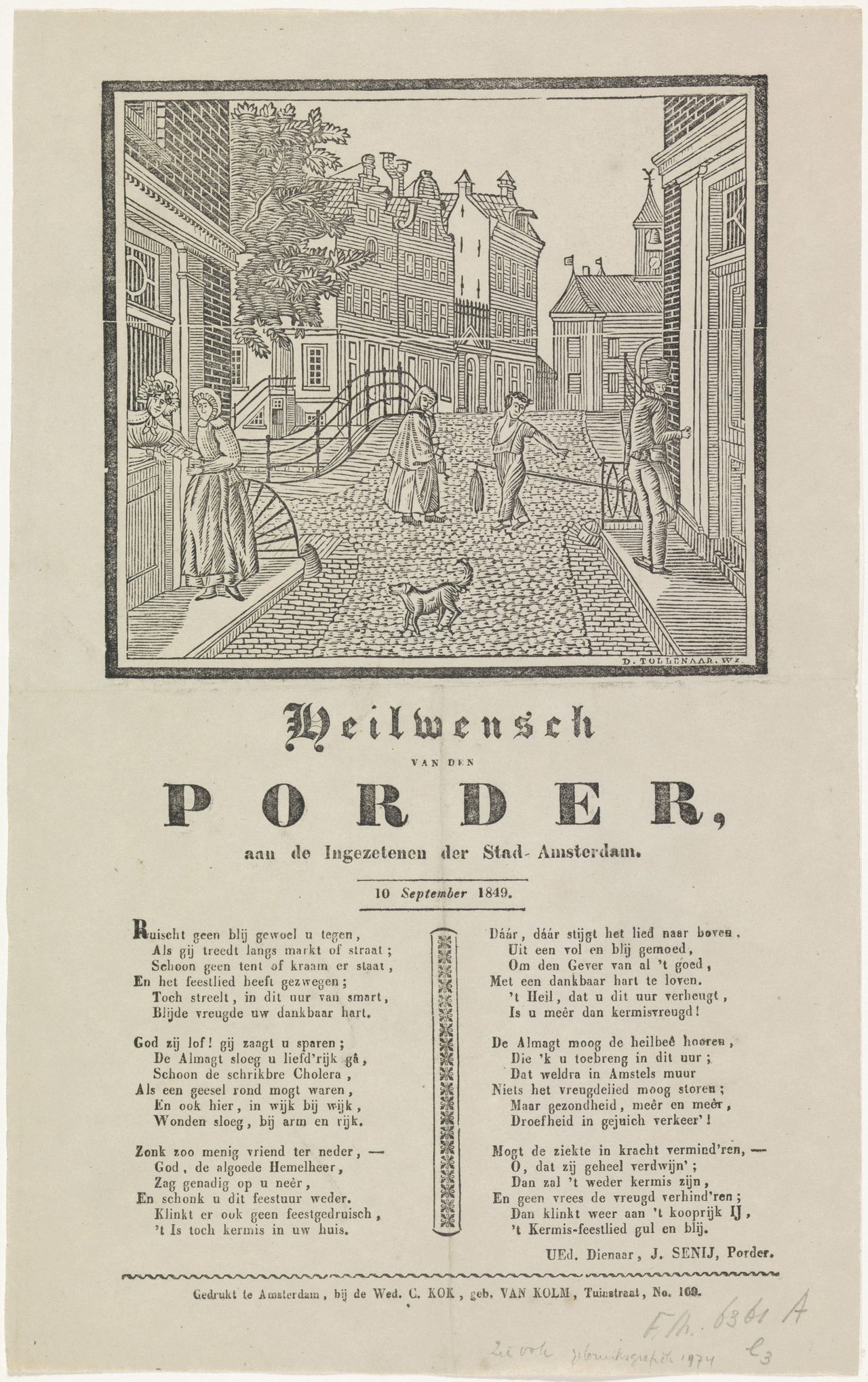
A boy with a long stick in an Amsterdam street, on the good-wishes sheet of a porder, a knocker-up, dated 10 September 1849.
- Image:
- D. Tollenaar Wz, a porder’s good-wishes sheet, woodcut, Amsterdam, 10 September 1849. Rijksmuseum, RP-P-OB-87.930.
- Source:
- Wu Zimu, Mengliang lu, vol. 13 (preface read as 1274), our translation
In the sources below, someone else usually does the waking: a temple postulant with a wooden fish, a man giving the call to prayer, a trumpeter, a rooster, a brother charged with the hour, a man with a long pole. A watch with an alarm was made in Amsterdam about 1725 to 1735, and no source we read dates when alarm clocks reached most bedsides. What Song China, the Islamic world, India, Rome, the monasteries, Edo and England’s mill towns did about getting up on time, with the original beside our English wherever we quote.
Song China: postulants at the door, and the weather
Meng Yuanlao reached the capital, Kaifeng, in 1103 and left it in 1127. In 1147 he dated the preface of the Dongjing meng hua lu, his book of what he remembered:
“Every day, as the fifth watch begins, the postulants of the temples and monasteries strike iron plaques or wooden fish and go from door to door announcing the dawn. Each also has his own district, where he begs for alms by day. All who are hurrying to court or to market hear this and get up.”
Meng Yuanlao, Dongjing meng hua lu, vol. 3, preface dated 1147. Our translation.
每日交五更,諸寺院行者打鐵牌子或木魚循門報曉,亦各分地分,日間求化。諸趨朝入市之人,聞此而起。
About 150 years separate that scene from the next one. Wu Zimu’s Mengliang lu describes Lin’an, today’s Hangzhou. Its preface carries a cyclical date that the Siku editors read as 1274, while doubting it.
“Every day, as the fourth watch begins, when the temples and abbeys in the hills have already rung their bells, the postulants and ascetic monks of the hermitages go along the streets striking little iron boards or little wooden fish to announce the dawn, each in his own district. If it is fine they say, ‘The sky is clear and bright’, or they announce ‘Great Attendance’, or ‘Four Attendances’, or ‘Regular Court’, or say ‘Sitting in the Rear Hall’. If it is cloudy they say, ‘The sky is overcast and dark’; if it rains they say, ‘Rain’. This is so that the officials, the guards and soldiers coming on duty, and the men on shift in every office know it and hurry to their posts. Even in wind, rain, frost or snow they dare not miss it. On the first and fifteenth of each month, and at festivals, they go from door to door begging food for their meals.”
Wu Zimu, Mengliang lu, vol. 13. Our translation.
每日交四更,諸山寺觀已鳴鐘,庵舍行者頭陀,打鐵板兒或木魚兒沿街報曉,各分地方。若晴則曰「天色晴明」,或報「大參」,或報「四參」,或報「常朝」,或言「後殿坐」;陰則曰「天色陰晦」;雨則言「雨」。蓋報令諸百官聽公上番虞候上名衙兵等人,及諸司上番人知之,趕趁往諸處服役耳。雖風雨霜雪,不敢缺此。每月朔望及遇節序,則沿門求乞齋糧。
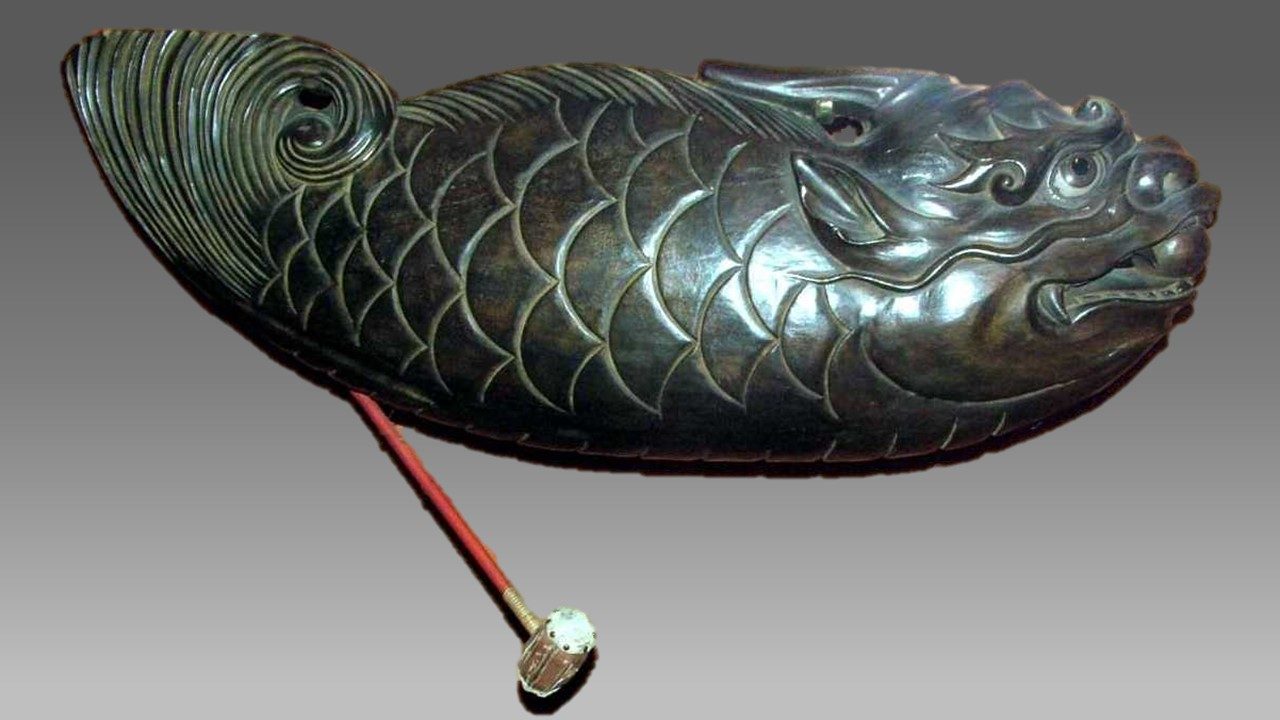
A wooden fish (mokugyo) and its beater, made in Japan in the 1800s: the kind of instrument both Song texts name, some 600 years later.
- Image:
- Wooden fish (mokugyo) and beater, wood, Japan, 1800s. The Metropolitan Museum of Art, 89.4.1711.
- Source:
- Meng Yuanlao, Dongjing meng hua lu, vol. 3 (preface dated 1147), our translation
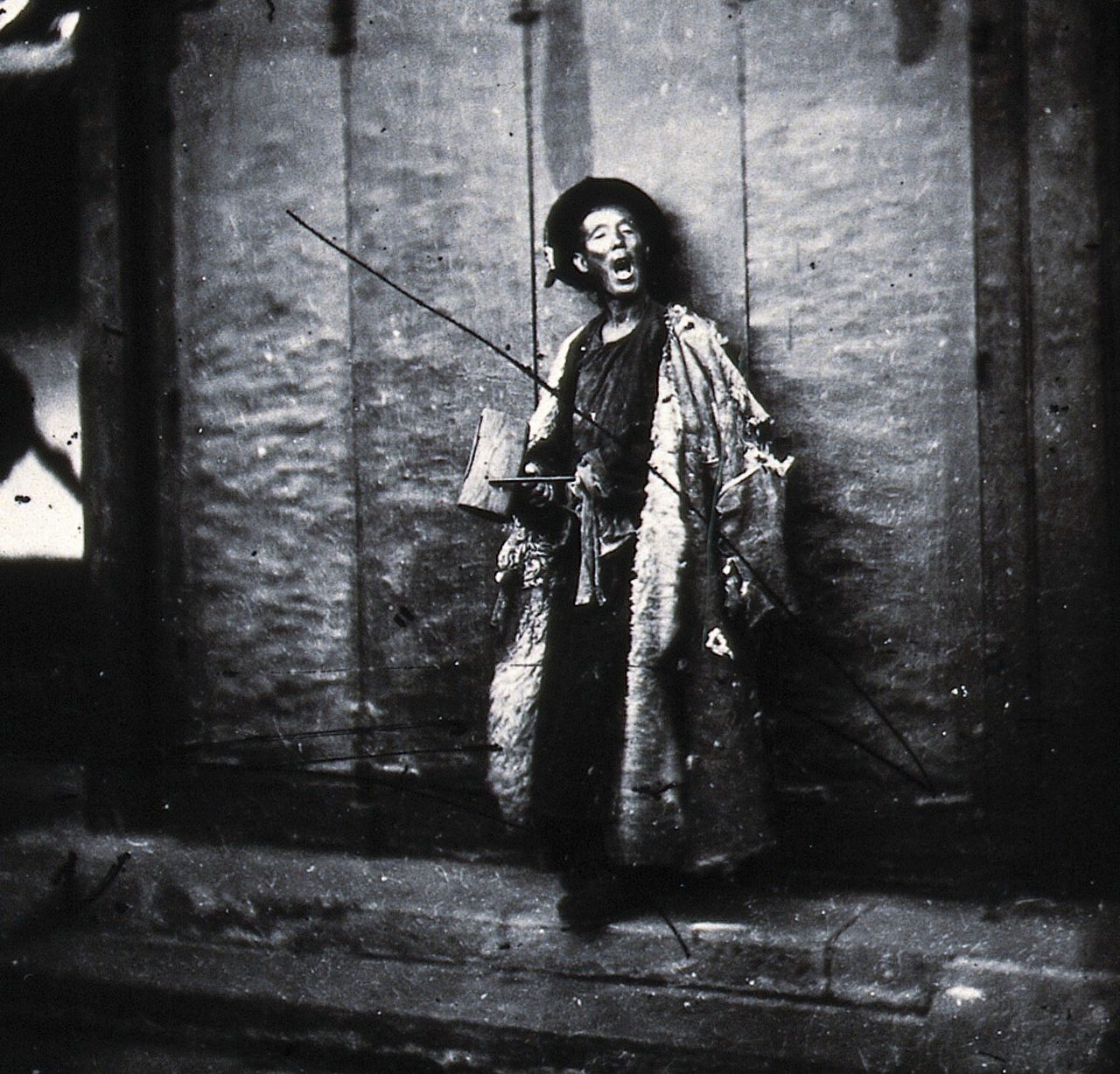
Old Wang, a night watchman in Peking, photographed by John Thomson in 1869. The print is lettered Canton; Thomson’s caption and the Wellcome Collection’s title say Peking.
- Image:
- John Thomson, a night watchman in Peking, photograph, 1869 (1981 print). Wellcome Collection. Public Domain Mark.
- Source:
- Wu Zimu, Mengliang lu, vol. 13 (preface read as 1274), our translation
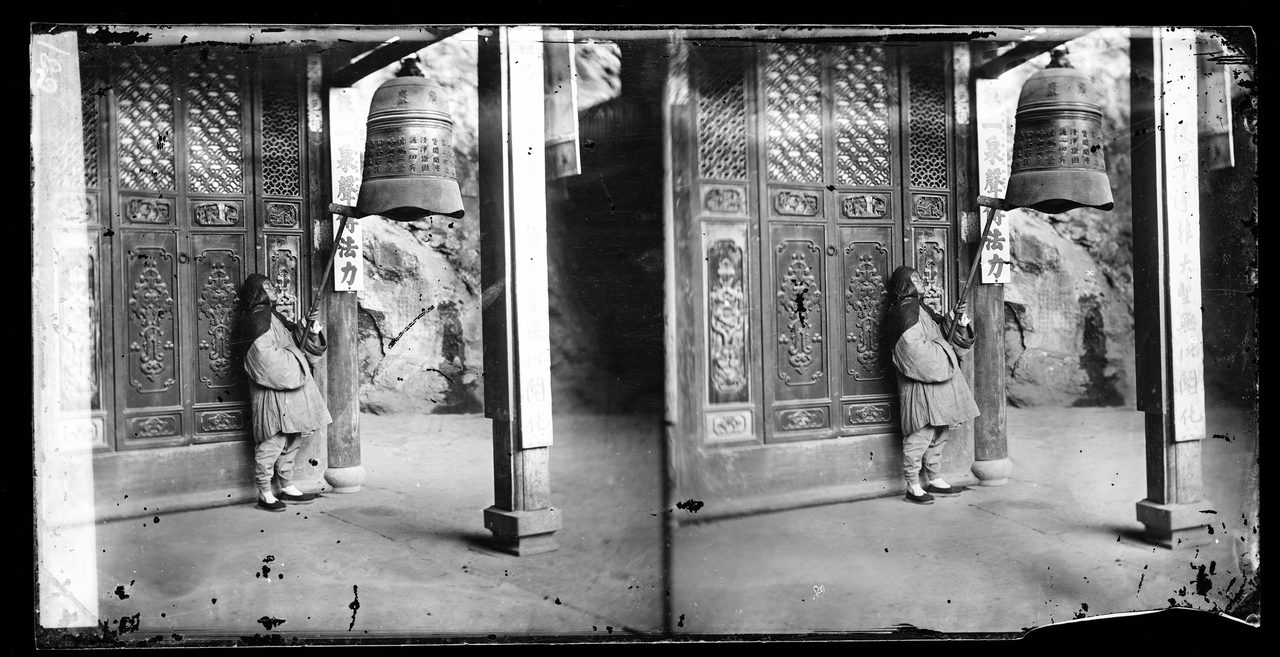
A monk strikes the bell at Fangguangyan monastery, Fujian, in a stereo photograph by John Thomson, 1870 to 1871.
- Image:
- John Thomson, a monk striking the bell at Fangguangyan monastery, Fujian, photograph, 1870 to 1871. Wellcome Collection. Public Domain Mark.
The four names between the weather calls are court sessions, rendered word for word; what each session was, we could not source. In the list of who hurries to work our two blind translators read two phrases differently, so the English keeps only what both were sure of.
Court texts name a caller of their own. The Zhou li (Rites of Zhou) lists the cock-man: “大祭祀,夜呼旦以叫百官”, “At the great sacrifices, at night he cries out the dawn to call the hundred officials.” Nothing in it says the officials were asleep. Wang Wei opens a court poem with him: “絳幘雞人送曉籌”, “The cock-man in a crimson headcloth brings in the dawn tally.” Both translations are ours.
In 1869 John Thomson photographed Old Wang, a night watchman in Peking. Wang is not a dawn-caller. Thomson wrote that he “employed also a wooden clapper to let the inmates of the house know he was astir, and to scare away thieves”. His government salary was “sufficient for his own support, yet by the time the amount reaches his hands through the official channel, it dwindles to about six shillings a month, and a regulation sheep-skin coat once a year” (Thomson, Illustrations of China and Its People, 1873 to 1874, as quoted in the Wellcome Collection’s record).
At a monastery in Fujian in 1870 to 1871, Thomson photographed a monk striking the bell. By the Wellcome Collection’s account, Thomson recalled being woken there each morning by the monks’ chanting or by the ringing of this bell. His 1898 book has a plate titled “The Morning Bell: Yuen-fu Monastery”.
The Islamic world: a call given while it is still night
Sahih al-Bukhari gives these words of the Prophet Muhammad about the call of Bilal, in the chapter on the call to prayer before dawn:
“Let not Bilal’s call to prayer keep any of you (or: anyone among you) from his pre-dawn meal, for he gives the call (or: calls out) while it is still night, to send back the one of you who is standing in prayer and to wake the one of you who is asleep. It does not mean that he is announcing dawn, or morning.”
Sahih al-Bukhari 621. Our translation.
لاَ يَمْنَعَنَّ أَحَدَكُمْ ـ أَوْ أَحَدًا مِنْكُمْ ـ أَذَانُ بِلاَلٍ مِنْ سَحُورِهِ، فَإِنَّهُ يُؤَذِّنُ ـ أَوْ يُنَادِي ـ بِلَيْلٍ، لِيَرْجِعَ قَائِمَكُمْ وَلِيُنَبِّهَ نَائِمَكُمْ، وَلَيْسَ أَنْ يَقُولَ الْفَجْرُ أَوِ الصُّبْحُ
The call for the dawn prayer carries a line of its own:
“If it is the dawn prayer, you say: Prayer is better than sleep, prayer is better than sleep.”
Sunan Abi Dawud 500. Our translation.
فَإِنْ كَانَ صَلاَةَ الصُّبْحِ قُلْتَ الصَّلاَةُ خَيْرٌ مِنَ النَّوْمِ الصَّلاَةُ خَيْرٌ مِنَ النَّوْمِ
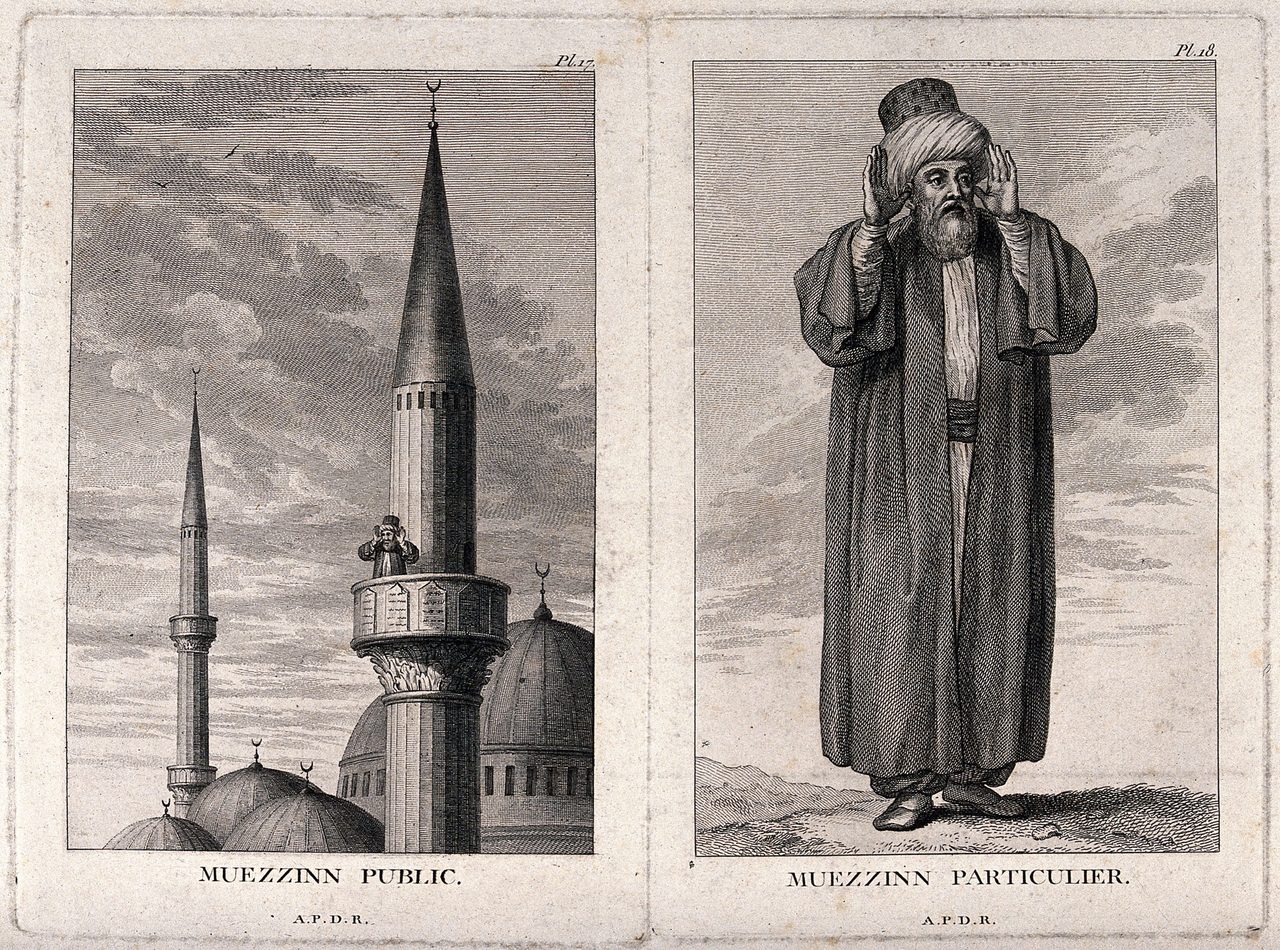
Two plates of 1787 after d’Ohsson: a muezzin on a minaret, lettered MUEZZINN PUBLIC, and a muezzin calling, lettered MUEZZINN PARTICULIER. The call to prayer, not Cairo’s Ramadan crier.
- Image:
- After d’Ohsson, a muezzin on a minaret and a muezzin calling, etching, 1787. Wellcome Collection. Public Domain Mark.
- Source:
- Sahih al-Bukhari 621; Sunan Abi Dawud 500. Our translations
Edward William Lane, an Englishman, published his account of the modern Egyptians in 1836: “Every night during Rum´ada´n, criers, called Moosahh´hhirs, go about, first to recite a complimentary cry, before the house of each Moos´lim who is able to reward him, and at a later hour to announce the period of the sahhoo´r, or last meal.” Two rounds, then. The first begins about two hours after sunset. “There is one of these criers to each khoot´t, or small district of Cairo.” He carries “a small drum, called ba´z”, and, “Having previously inquired the names of the inmates of each house, he greets each person, excepting women, in the same manner; mentioning every brother, son, and young unmarried daughter of the master”. The call for the last meal comes on the second round.
Lane tells one more scene with the evening greetings, not with the later call: “At many houses of the middle classes in Cairo, the women often put a small coin [...] into a piece of paper, and throw it out of a window to the moosahh´hhir; having first set fire to the paper, that he may see where it falls: he then, sometimes by their desire, and sometimes of his own accord, recites the Fa´t´hhah, and relates to them a short tale, in unmeasured rhyme, for their amusement”. The women are awake, and listening to a story.
India: a king woken by trumpets, water clocks, and a gong
The Arthashastra, in R. Shamasastry’s translation of 1915, sets out a king’s day: “Hence the king shall ever be wakeful.” Day and night are divided into eighths by nálikas “or according to the length of the shadow”, and a náliká is “the time during which one ádhaka of water passes out of a pot through an aperture”. The king goes to bed “amid the sound of trumpets” in the third part of the night and is “awakened by the sound of trumpets during the sixth part”. On a twelve-hour night from 6 p.m. that is about 1.30 to 3 a.m., by our reckoning.
The Chinese monk Yijing wrote of the monasteries of India:
“Moreover, throughout the Five Indias, every great monastery has had a water clock set up by order of the kings, and so keeping the hours by day and night is not hard. Following the Vinaya, the night is divided into three parts: in the first and the last, meditation and recitation are required, and in the middle one rests as one pleases.”
Yijing, Da Tang xiyu qiufa gaoseng zhuan, vol. 1. Our translation.
又五天之地,但是大寺,君王悉皆令置漏水,為此晝夜期候不難。准如律教,夜分三分,初後制令禪誦,中間隨意消息。
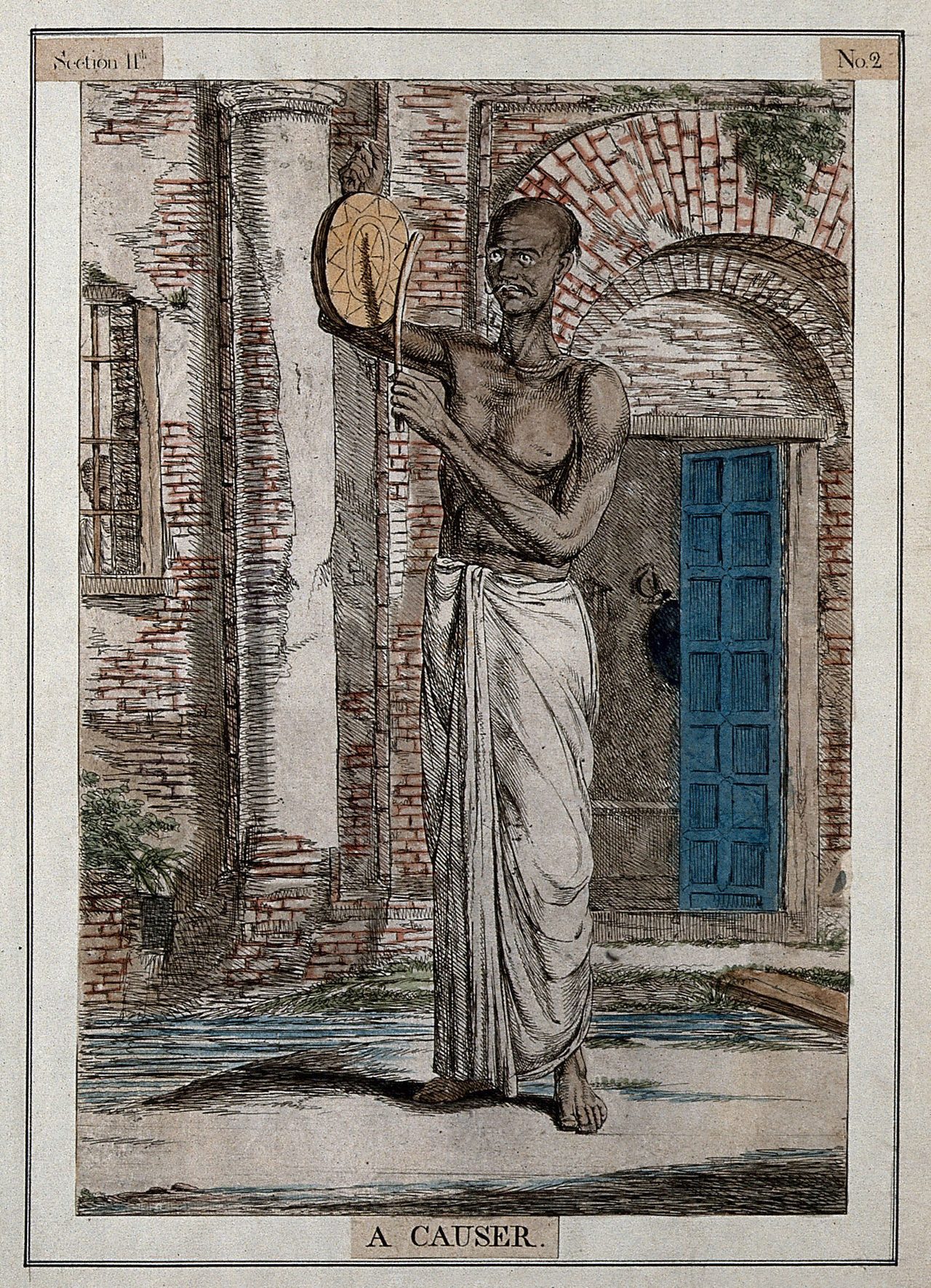
A causer, a gong “beat at stated times by the servants of priests”, in an ink note on the print, by the Wellcome Collection’s record. Calcutta, 1799. A priests’ gong, not Babur’s town gong.
- Image:
- F. B. Solvyns, a man striking a causer, a gong of the priests’ servants, coloured etching, Calcutta, 1799. Wellcome Collection. Public Domain Mark.
- Source:
- Yijing, Da Tang xiyu qiufa gaoseng zhuan, vol. 1, our translation; Babur-nama, tr. A. S. Beveridge (1922)
In another book, in J. Takakusu’s translation of 1896, Yijing adds: “clepsydrae are much used in great monasteries in India. These together with some boys who watch them are gifts from kings”. A drum was struck each time the bowl sank and a conch blown at the hour, so that “even when rainy nights continue, there is no fear of missing the watches”. The purpose, in his words: “announcing hours to the monastics”.
Babur, in his memoirs for 932 AH (1525 to 1526), found that in “all considerable towns” of Hindustan men called g’harialis struck a brass plate “perhaps as large as a tray” to mark the time. He changed the signal for the night and for cloudy days, and wrote that it “did very well”: now “anyone happening to wake in the night and hear the gong” would know which g’hari, a span of 24 minutes, of which night watch it was (tr. Annette Susannah Beveridge, 1922). The change was for whoever already lay awake.
Rome: roosters, bakers and a schoolmaster
Pliny the Elder, on the cock:
“Next in their feeling for glory come these night watchmen of ours, whom nature made to rouse mortals to their work and to break their sleep. They know the stars, and by day they mark every third hour with their crowing. They go to bed with the sun, and at the fourth watch of the camp they call us back to our cares and toil; they do not let the sunrise creep up on the unwary, and they announce the coming day with their crowing, and the crowing itself with a clapping of their sides.”
Pliny the Elder, Natural History 10.46, 1st century CE. Our translation.
Proxime gloriam sentiunt et hi nostri vigiles nocturni, quos excitandis in opera mortalibus rumpendoque somno natura genuit. norunt sidera et ternas distinguunt horas interdiu cantu. cum sole eunt cubitum quartaque castrensi vigilia ad curas laboremque revocant nec solis ortum incautis patiuntur obrepere diemque venientem nuntiant cantu, ipsum vero cantum plausu laterum.
Martial’s Rome had other noises:
“In the city, Sparsus, a poor man has no place to think or to rest. Schoolmasters deny you a life in the morning, bakers at night, the coppersmiths’ little hammers all day long. [...] Who can count the losses of lazy sleep? [...] Me, the laughter of the passing crowd wakes, and Rome is at my bedside.”
Martial, Epigrams 12.57. Our translation.
Nec cogitandi, Sparse, nec quiescendi / In urbe locus est pauperi. Negant vitam / Ludi magistri mane, nocte pistores, / Aerariorum marculi die toto; [...] Numerare pigri damna quis potest somni? [...] Nos transeuntis risus excitat turbae, / Et ad cubilest Roma.
The schoolmaster starts before the birds:
“What have you to do with us, wicked schoolmaster, a head hated by boys and girls? The crested cocks have not yet broken the silence, and already you thunder with savage growls and blows. [...] We, your neighbours, ask for sleep, and not the whole night: to lie awake is a light thing, to lie awake all night is heavy. Send your pupils home. Chatterbox, would you take as much to be quiet as you take to shout?”
Martial, Epigrams 9.68. Our translation.
Quid tibi nobiscum est, ludi scelerate magister, / invisum pueris virginibusque caput? / nondum cristati rupere silentia galli: / murmure iam saevo verberibusque tonas. [...] vicini somnum - non tota nocte - rogamus: / nam vigilare leve est, pervigilare grave est. / discipulos dimitte tuos. Vis, garrule, quantum / accipis ut clames, accipere ut taceas?
The neighbours’ offer is a question; the poem does not say he took it. And the baker, in a two-line poem: “Surgite: iam vendit pueris ientacula pistor / Cristataeque sonant undique lucis aves”, “Get up: the baker is already selling the boys their breakfasts, and the crested birds of daylight are sounding on every side.” (Martial, Epigrams 14.223, our translation).
Petronius has a joke about a rich man, Trimalchio, told by another man’s slave. It is satire, not a record of how Romans woke:
“He has a clock in his dining room, and a trumpeter kept ready for the purpose, so that he can know from time to time how much of his life he has lost!”
Petronius, Satyricon 26. Our translation.
Horologium in triclinio et bucinatorem habet subornatum, ut subinde sciat quantum de vita perdiderit!
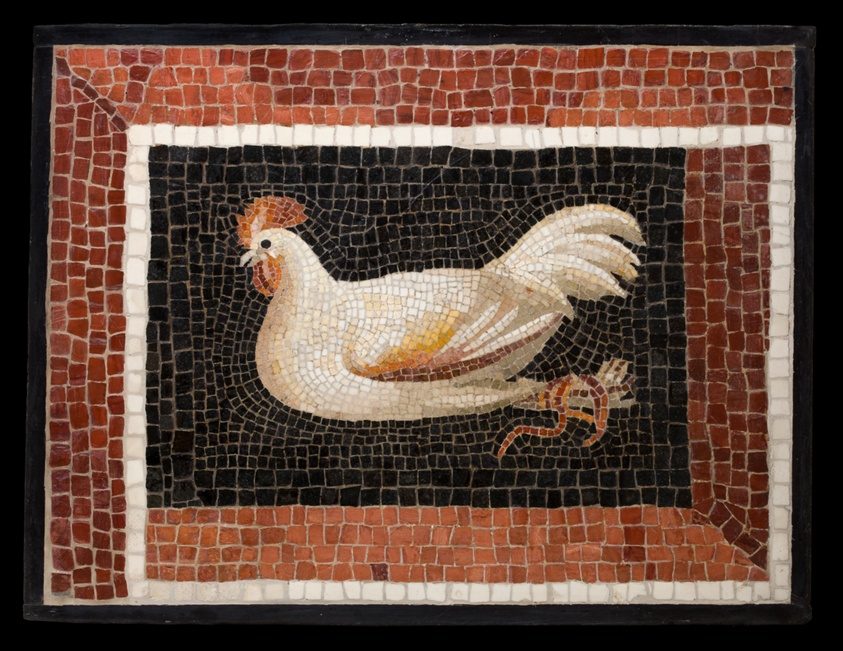
A bound rooster on a Roman mosaic floor panel, 2nd century, one of eight panels, six of them still lifes of food, by the Art Institute of Chicago’s record. Not crowing: his feet are tied.
- Image:
- A bound rooster, mosaic floor panel, stone and mortar, Rome, 2nd century. The Art Institute of Chicago, 2024.1011.
- Source:
- Pliny, Natural History 10.46; Martial, Epigrams 12.57. Our translations
The monastery night
The Rule of Benedict makes calling the hour a named job:
“Announcing the hour of the Work of God, by day and by night, shall be the abbot’s charge: let him announce it himself, or lay this charge on a brother careful enough that everything is done at the proper hours.”
Rule of Benedict, ch. 47. Our translation.
Nuntianda hora operis Dei dies noctisque sit cura abbatis; aut ipse nuntiare aut tali sollicito fratri iniungat hanc curam, ut omnia horis conpetentibus conpleantur.
And it plans for the sleepy:
“Let a candle burn without a break in that room until morning. Let them sleep clothed, girded with belts or cords, and without their knives at their sides while they sleep, lest by chance they wound a sleeper in a dream; and so that the monks may always be ready and, rising without delay when the signal is given, may hurry to be ahead of one another at the Work of God, yet with all gravity and modesty. [...] And when they rise for the Work of God, let them gently urge one another on, because of the excuses of the sleepy.”
Rule of Benedict, ch. 22. Our translation.
Candela iugiter in eadem cella ardeat usque mane. Vestiti dormiant et cincti cingulis aut funibus, ut cultellos suos ad latus suum non habeant dum dormiunt, ne forte per somnium vulnerent dormientem; et ut parati sint monachi semper et, facto signo absque mora surgentes, festinent invicem se prævenire ad opus Dei, cum omni tamen gravitate et modestia. [...] Surgentes vero ad opus Dei invicem se moderate cohortentur propter somnulentorum excusationes.
The hour is set too: “Hiemis tempore, id est a kalendas novembres usque in Pascha, iuxta considerationem rationis, octava hora noctis surgendum est, ut modice amplius de media nocte pausetur et iam digesti surgant”, “In wintertime, that is, from the first of November until Easter, as reason sees fit, they are to rise at the eighth hour of the night, so that they rest a little longer than half the night and rise with their food digested.” (Rule of Benedict, ch. 8, our translation).
At Bury St Edmunds, on the night of St Etheldreda in 1198, the shrine caught fire. Jocelin of Brakelond:
“For in the same hour the clock struck before the hour of matins, and the master of the vestry arose and perceived and knew of the fire. Then he ran at once, and sounding the gong, as if for a dead man, he cried with a loud voice and said that the shrine was on fire. [...] Then the young men ran for water, some to the well and some to the clock, and some used their hoods, and with great labour put out the fire.”
Jocelin of Brakelond, Chronicle, on the fire of 1198, tr. L. C. Jane, 1907.
Eadem enim hora cecidit horologium ante horas matutinas, surgensque magister vestiarii, hoc percipiens et intuens, cucurrit quamtocius et, percussa tabula tanquam pro mortuo, sublimi voce clamavit dicens feretrum esse conbustum. [...] Juvenes ergo nostri propter aquam currentes, quidam ad puteum, quidam ad horologium, quidam cucullis suis impetum ignis cum magna difficultate extinxerunt
Jocelin never calls the clock an alarm, and never says it woke the monk: the clock struck, and the monk who got up found the fire. That the clock held water is our reading of “some to the clock”.
Edo: a bell its listeners seem to have paid for
In everyday Japan the hours were unequal, day and night each split into six, until 1873. Edo’s first public time bell is said to have been set up at Honkokuchō under the second shogun and to have rung about every two hours. After the great fire of 1657 more bells were added, until the town magistrates ran two, Honkokuchō’s among them, and the magistrate for temples and shrines 13, counting later moves. The houses within earshot of the Kokuchō bell, 410 town blocks in all, seem to have paid bell money of 4 mon a month per house-owner (after Masuyama Kazunari, Chūō City Board of Education, 2024). Masuyama quotes an Edo comic verse, a senryū, without naming its collection:
“Kokuchō now puts Edo to sleep, now wakes it up.”
An Edo senryū, as quoted by Masuyama Kazunari, 2024. Our translation.
石町は江戸を寝せたり起こしたり
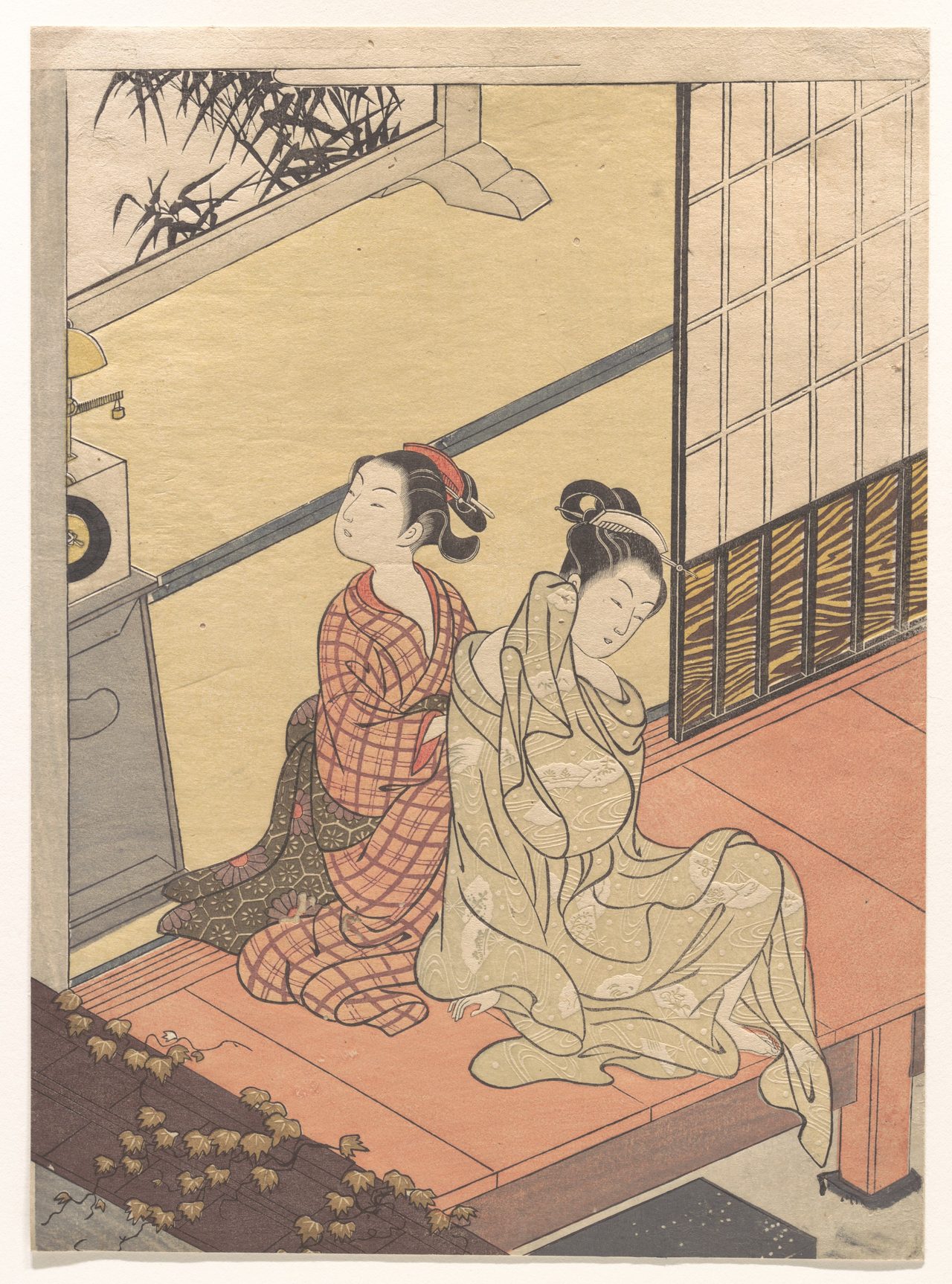
Evening Chime of the Clock, by Suzuki Harunobu, about 1766: a house clock on its stand at the left edge strikes the hour. Evening, not dawn.
- Image:
- Suzuki Harunobu, Evening Chime of the Clock, from Eight Parlor Views, woodblock print, ca. 1766. The Metropolitan Museum of Art, JP2447.
- Source:
- After Masuyama Kazunari, Chūō City Board of Education (2024); the verse in our translation
The Seiko Museum Ginza holds a late-Edo lantern clock with a double foliot that both struck the hours and had an alarm.
England and Amsterdam, 1849 to 1934: the knocker-up
Robert Holland’s Cheshire glossary of 1886 has the definition: “KNOCKER-UP, s. one who calls up factory hands in the morning. The very curious avocation of waking the mill hands in the manufacturing towns early in the morning, so that they may be able to get to their work in good time, and avoid being fined for being late, is quite a special and recognised business. The knocker-up is paid, I believe, about twopence per head per week. He carries a long pole with which he taps at the bedroom windows of his clients.”
The newspaper lines on this page come from New Zealand papers. We read them as the scans’ machine-read text, not on the page images, so they are quoted in lower case as that text gives them. The Otago Witness, 19 September 1889: he receives “from 3d to 6d a week” from each client, and if the tap fails “he will rattle the door or thunder at the shutters”. The Mataura Ensign, 17 June 1892, reprinted “Ten Minutes with a Knocker-Up” from Cassell’s Journal. The man woke people “by rattling wires fastened to a long stick” against their windows. He said he had “above two hundred to knock up every morning”, and “they pay me 2d a week”. Also: “nearly everybody among working folk has a knocker-up”. And he admitted that he sometimes overslept a little, and then had to tell his clients to hurry because he was late. The trade, the piece says, is “a favourite refuge for men” grown too old for their own work. The Star of Christchurch, 12 January 1909, in a report headed “A Lancashire Strike”: “the knocker-up [...] finds his occupation gone”.
Amsterdam’s word was porder. The Rijksmuseum holds eight records of the porders’ printed good wishes: New Year sheets for 1845, 1849, 1850, 1875 and 1896, fair sheets for 1849 and 1875, and newspaper pages of 31 December 1910. The fair sheet of 1849 is headed “Heilwensch van den Porder, aan de Ingezetenen der Stad-Amsterdam. 10 September 1849”, “Good wishes from the porder to the inhabitants of the city of Amsterdam. 10 September 1849.” It is signed “UEd. Dienaar, J. SENIJ, Porder”, “Your Honours’ servant, J. Senij, porder.” Its verse:
“Though no happy bustle meets you as you walk through market or street, though no tent or stall stands there and the fair song has fallen silent, still, in this hour of sorrow, glad joy caresses your grateful heart. God be praised! You saw yourselves spared; the Almighty watched over you with love, though the dreadful cholera was allowed to roam about like a scourge and here too, district by district, struck wounds among poor and rich. [...] Though no festive din rings out, it is still fair-time in your house. [...] May the sickness lessen in strength, O, may it vanish altogether; then it will be fair-time again.”
Heilwensch van den Porder, signed J. Senij, Amsterdam, 10 September 1849. Our translation.
Ruischt geen blij gewoel u tegen, / Als gij treedt langs markt of straat; / Schoon geen tent of kraam er staat, / En het feestlied heeft gezwegen; / Toch streelt, in dit uur van smart, / Blijde vreugde uw dankbaar hart. / God zij lof! gij zaagt u sparen; / De Almagt sloeg u liefd'rijk gâ, / Schoon de schrikbre Cholera, / Als een geesel rond mogt waren, / En ook hier, in wijk bij wijk, / Wonden sloeg, bij arm en rijk. [...] Klinkt er ook geen feestgedruisch, / 't Is toch kermis in uw huis. [...] Mogt de ziekte in kracht vermind'ren, / O, dat zij geheel verdwijn'; / Dan zal 't weder kermis zijn,
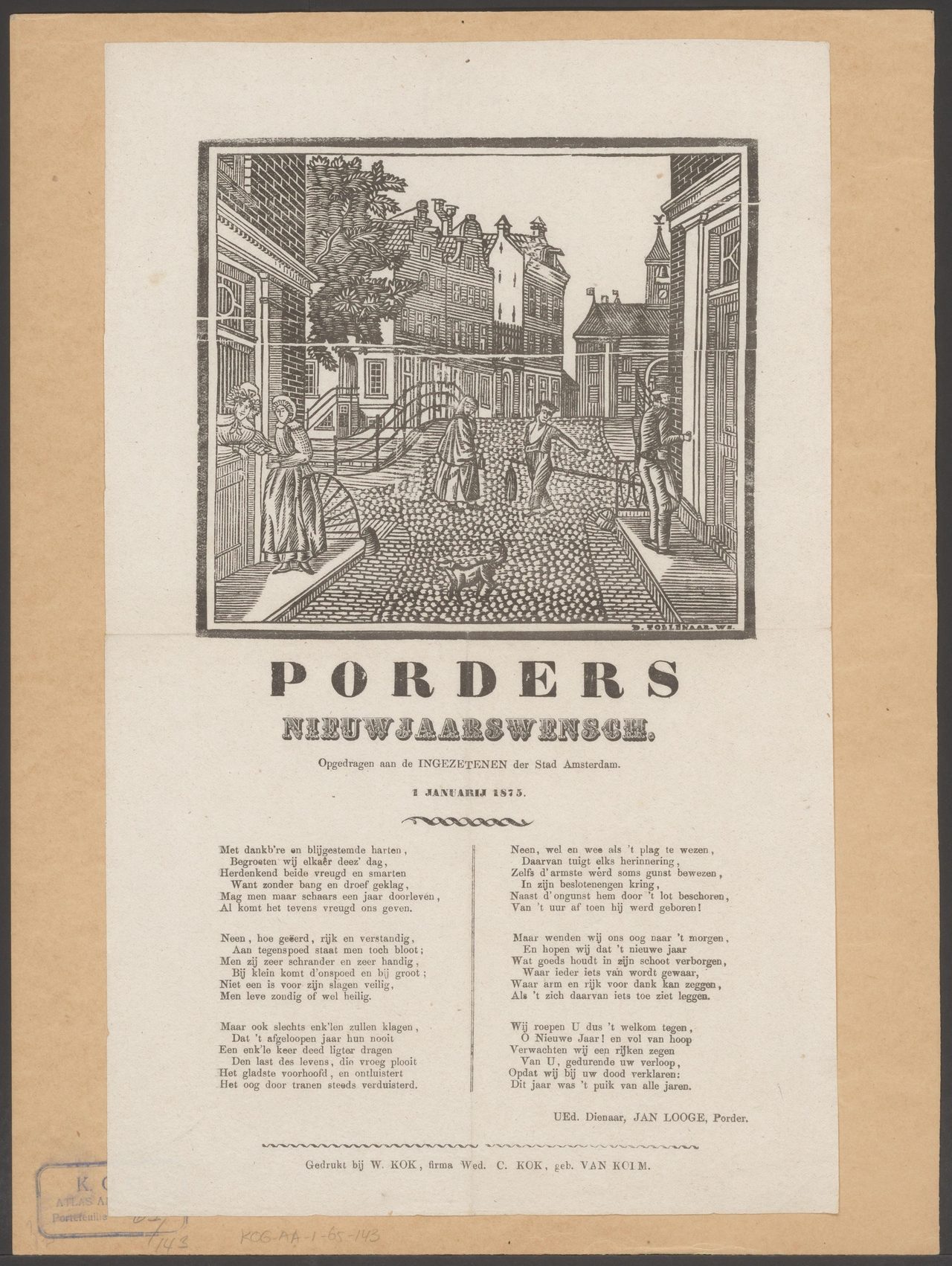
The porders’ New Year sheet for 1875, Amsterdam: the woodblock of the 1849 sheet, reused 26 years on. An Amsterdam porder, not an English knocker-up.
- Image:
- D. Tollenaar Wz, a porder’s New Year sheet, woodcut, Amsterdam, 1 January 1875. Rijksmuseum, KOG-AA-1-65-143.
- Source:
- Mataura Ensign, 17 June 1892, from Cassell’s Journal; Evening Post (Wellington), 14 June 1934
The verse says there was no fair that year because of the sickness; an official cancellation is not shown. The New Year sheet for 1875, signed Jan Looge, porder, prints the same woodblock 26 years on.
On 14 June 1934 the Evening Post of Wellington printed an unsigned piece, “The Knocker-Up”, about a mining village in England. Its line: “one may think that alarm clocks are cheap enough”. Cheap or not, the piece goes on, it gets complicated when three or four people in one house want waking at different times. The piece reports that the knocker-up walked a beat like a policeman’s, and that a door chalked 345 told him three people inside wanted waking: one at three, one at four and one at five.
The Americas: two glimpses
Charles Eastman (Ohiyesa), born in 1858, remembered his Dakota boyhood in a book of 1902. His uncle “began to give sudden war-whoops over my head in the morning while I was sound asleep. He expected me to leap up with perfect presence of mind”, or fired his gun “just outside of the lodge while I was yet asleep”. That is training a boy to wake ready, not to wake on time.
The Codex Mendoza (about 1541, or by 1553 at the latest) shows a man whose job was to watch the stars at night to tell the hour (after Stephanie Wood, Visual Lexicon of Aztec Hieroglyphs).
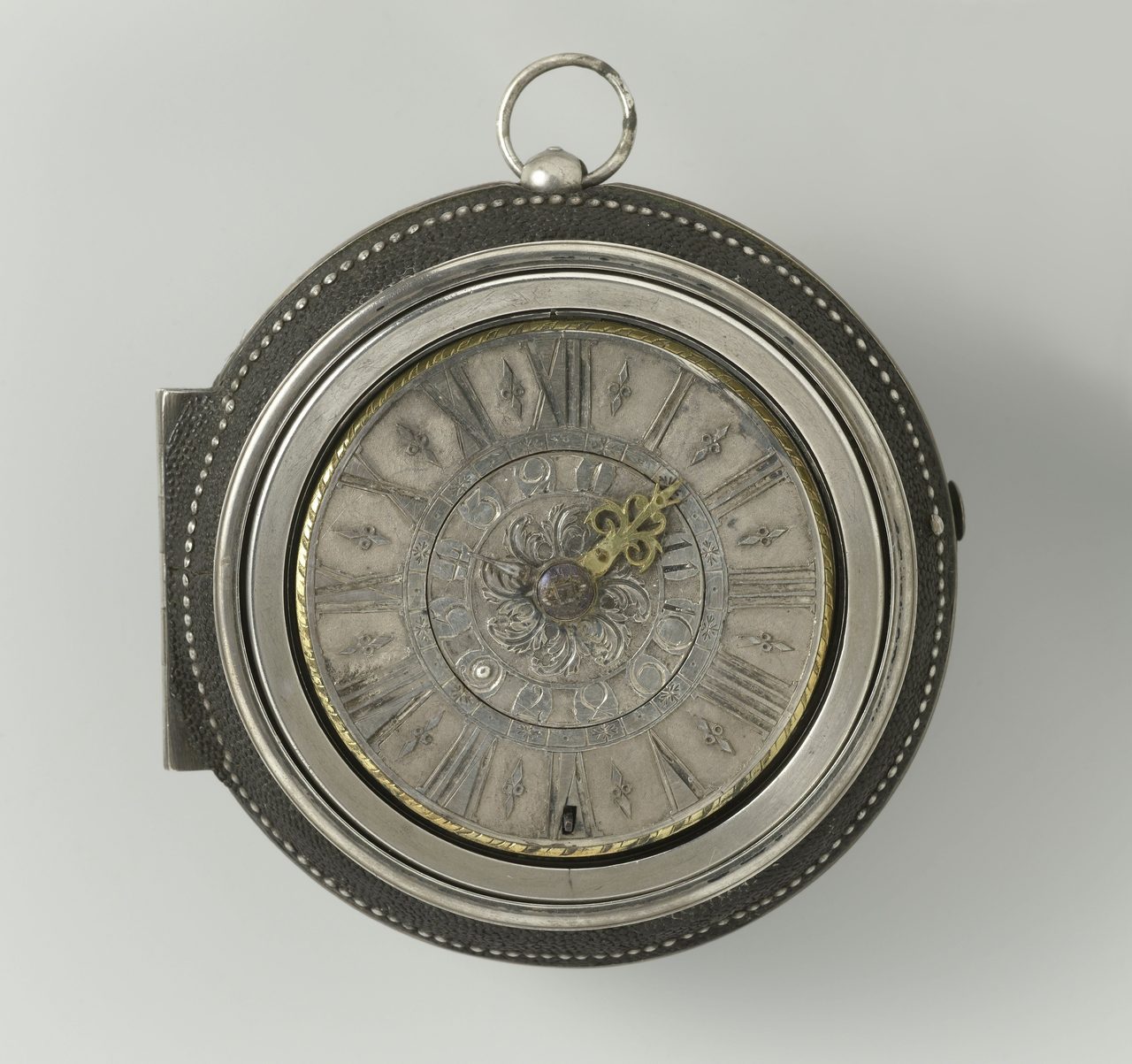
A watch with an alarm, signed Paulus Bramer, Amsterdam, about 1725 to 1735, in silver, copper and sharkskin. It is not offered as a first.
- Image:
- Paulus Bramer, watch with alarm, silver, copper and sharkskin, Amsterdam, c. 1725 to 1735. Rijksmuseum, BK-NM-3202.
- Source:
- Athenaeus 4.174c, tr. C. D. Yonge (1854); The Autobiography of Levi Hutchins (1865); US Patent 183,725
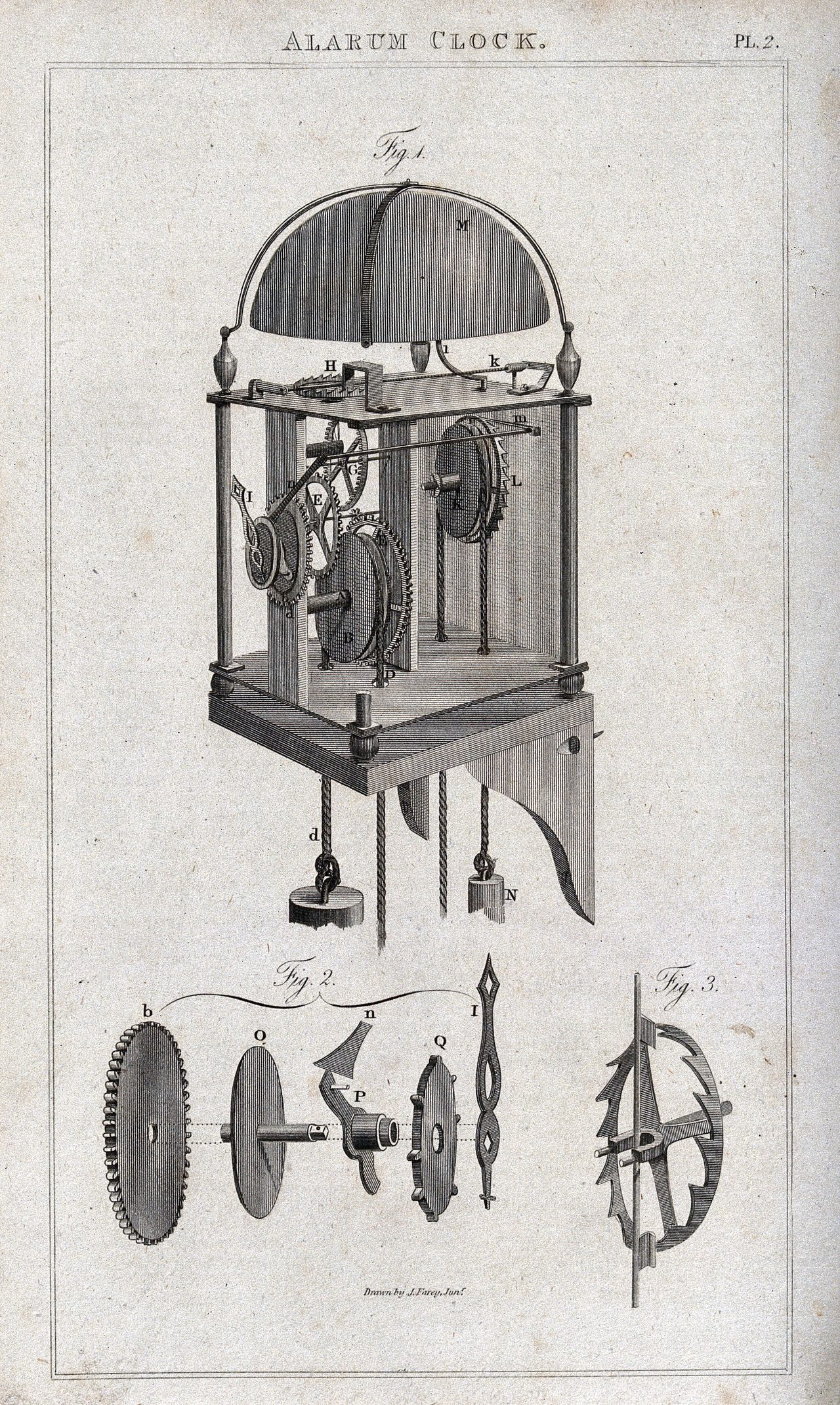
Alarum Clock, plate 2, drawn by J. Farey Jr: a weight-driven movement under a bell. The record gives the engraving no date.
- Image:
- After J. Farey Jr, Alarum clock, plate 2, engraving, London, undated. Wellcome Collection. Public Domain Mark.
No first, and no year
The sources we read give no first alarm clock, and no year when alarm clocks reached most bedsides. They give dated things. In 1198 a monastery clock struck before matins. About 1725 to 1735 Paulus Bramer of Amsterdam made a watch with an alarm; its silver dial has an alarm ring, by the Rijksmuseum’s record. In a reprint of 17 June 1892 a knocker-up could say that “nearly everybody among working folk has a knocker-up”. On 14 June 1934, 42 years later, a newspaper could write “one may think that alarm clocks are cheap enough” about a village where the knocker-up still walked his round.
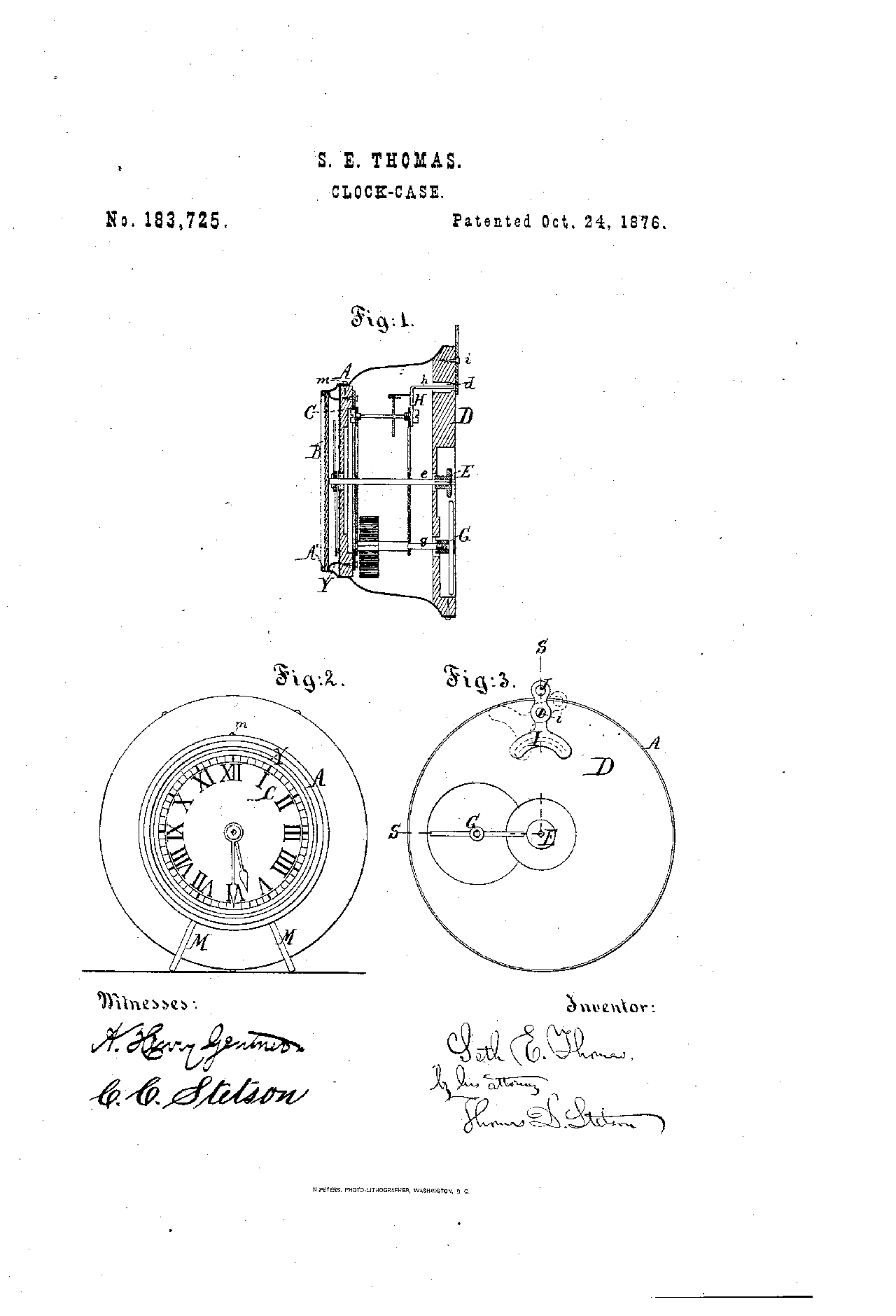
The drawing sheet of US patent 183,725, 24 October 1876: a clock case, with no bell or alarm drawn.
- Image:
- S. E. Thomas, Clock-Case, US Patent 183,725, drawing, 24 October 1876. United States Patent and Trademark Office.
The stories that don’t hold up
- “Plato invented the alarm clock.”
The source is Athenaeus, quoting Aristocles, who says only that it is said: “λέγεται δὲ Πλάτωνα μικράν τινα ἔννοιαν δοῦναι τοῦ κατασκευάσματος νυκτερινὸν ποιήσαντα ὡρολόγιον ἐοικὸς τῷ ὑδραυλικῷ οἷον κλεψύδραν μεγάλην λίαν”, “it is said, that Plato showed a sort of notion of the invention, making a nightly clock like the hydraulic organ” (Deipnosophistae 4.174c, tr. C. D. Yonge, 1854). The Greek goes on to liken it to a very large water clock. Third-hand, and nothing about sound or waking.
- “Ctesibius built water alarms that whistled at a set time.”
Vitruvius lists what the water clocks did besides tell the time: “moventur sigilla, vertuntur metae, calculi aut ova proiciuntur, bucinae canunt, reliquaque parerga”, “little figures move, cones turn, pebbles or eggs are thrown out, trumpets sound, and the other extras” (De architectura 9.8.5, our translation). Nothing in the passage is set for a chosen hour, and nothing in it wakes anyone.
- “Levi Hutchins of Concord, New Hampshire, invented the alarm clock in 1787.”
His Autobiography (1865) describes his clock-making and never mentions an alarm, in either of the two scans searched. His son’s addenda say: “In winter he arose at four o’clock”. A newspaper telling of 2020 has a clock fixed at 4 a.m. and gives no source. The Bramer watch with an alarm is more than 50 years older than the story.
- “Seth E. Thomas patented the first wind-up alarm clock on 24 October 1876.”
US patent 183,725 of that date is titled “Improvement in clock-cases”. Its text says “The works need involve no novelty” and covers the case, winding, setting, regulation and a hanging ring. There is no alarm anywhere in it. His other patents were not checked.
- “Knocker-ups used pea-shooters.”
The three accounts above give a long pole (1886), a long cane (1889) and wires fastened to a long stick (1892). The 1892 writer first took the noise for “the rattle of peas” from a giant shooter; then “the supposed man with the pea-shooter” turned out to carry the stick.
- “Roosters crow at dawn.”
They start before dawn, on an internal circadian clock, the top-ranking bird first, and they also crow when something sets them off (after Shimmura, Ohashi and Yoshimura, Scientific Reports, 2015, and Shimmura and Yoshimura, Current Biology, 2013).
- “Incense alarm clocks date from about 1100.”
Hong Chu’s Xiang pu describes an incense that tells the time, with nothing about waking: “近世尚竒者作香篆其文準十二辰分一百刻凡然一晝夜乃巳”, “In recent times those who love novelties make incense seals, the pattern ruled to the twelve double-hours and divided into a hundred ke. Lit, it burns through a whole day and night and only then is spent.” (our translation). In Fujian, Thomson saw a joss-stick timepiece: “Each stick will burn for twelve hours”, and “Thus the time of day or night might be ascertained at a glance”. An early 19th-century Chinese dragon incense clock at Royal Museums Greenwich dropped metal weights onto a metal tray with a clang, which the museum calls a regular time signal.
- “The Ramadan crier goes back to Bilal.”
Bilal’s night call is in Sahih al-Bukhari. The district crier with his drum is in Lane (1836). No source we read links the two.
- “Before alarm clocks nobody needed to wake at a set time.”
Benedict’s monks rose at the eighth hour of the night in winter. Kaifeng’s callers woke people bound for court and market. The Arthashastra’s king was woken in the sixth part of the night. Bilal’s call came while it was still night, and Martial’s two lines say to get up because the baker is already selling breakfast.
Sources
- Meng Yuanlao, Dongjing meng hua lu, vol. 3, section 天曉諸人入市 ; preface and Siku note (1103, 1127, 1147).
- Wu Zimu, Mengliang lu, vol. 13, section 天曉諸人出市 ; preface and Siku note (the date read as 1274).
- Zhou li, Chunguan, the cock-man.
- Wang Wei, poem in reply to Secretary Jia’s “Early audience at the Daming Palace”, line 1.
- John Thomson on Old Wang (Illustrations of China and Its People, 1873 to 1874), as quoted in the Wellcome Collection’s record of his negative.
- Wellcome Collection, record of Thomson’s stereo negative of the bell (the waking line is the record’s).
- John Thomson, Through China with a Camera (1898), pp. 156 to 157 and the list of plates.
- Hong Chu, Xiang pu, vol. 2, entry 百刻香 (Siku quanshu text).
- Royal Museums Greenwich, incense clock ZAA0758.
- Sahih al-Bukhari 621, Arabic text.
- Sunan Abi Dawud 500, Arabic text.
- Edward William Lane, An Account of the Manners and Customs of the Modern Egyptians (London, 1836), vol. 2, pp. 234 to 236.
- Kautilya, Arthashastra 1.19 and 2.20, tr. R. Shamasastry (Bangalore, 1915): Arthashastra Book I ; Arthashastra Book II.
- Yijing, Da Tang xiyu qiufa gaoseng zhuan, vol. 1.
- Yijing, A Record of the Buddhist Religion as Practised in India and the Malay Archipelago, tr. J. Takakusu (Oxford, 1896), ch. XXX, pp. 144 to 146.
- Babur, Babur-nama, tr. Annette Susannah Beveridge (1922), vol. 2, pp. 516 to 517.
- Pliny the Elder, Naturalis Historia 10.46, ed. Mayhoff. Perseus Digital Library Latin texts, file phi0978.phi001.perseus-lat2.xml.
- Martial, Epigrams 12.57, 9.68 and 14.223: www.thelatinlibrary.com ; www.thelatinlibrary.com ; www.thelatinlibrary.com.
- Petronius, Satyricon 26.
- Rule of Benedict, ch. 8, 22 and 47.
- Jocelin of Brakelond, Chronicle, Latin ed. J. G. Rokewode (1840), pp. 78 to 79 ; tr. L. C. Jane (London, 1907), pp. 167 to 168.
- Masuyama Kazunari, Chūō City Board of Education, column of 21 March 2024 on the Kokuchō time bell.
- Seiko Museum Ginza, “Lantern Clock with Double Foliot Balance”.
- Robert Holland, A Glossary of Words Used in the County of Chester (1886), p. 192.
- “Some Out-of-the-Way Callings”, Otago Witness, 19 September 1889.
- “Ten Minutes with a Knocker-Up”, Mataura Ensign, 17 June 1892, reprinted from Cassell’s Journal.
- “A Lancashire Strike”, Star (Christchurch), 12 January 1909.
- “The Knocker-Up”, Evening Post (Wellington), 14 June 1934.
- Rijksmuseum, the porders’ sheets (eight records).
- Charles A. Eastman (Ohiyesa), Indian Boyhood (New York, 1902), p. 57.
- Stephanie Wood, Visual Lexicon of Aztec Hieroglyphs, entry for Codex Mendoza folio 63r.
- Athenaeus, Deipnosophistae 4.174c, Greek ed. Kaibel and English tr. C. D. Yonge (London, 1854), Perseus Digital Library.
- Vitruvius, De architectura 9.8.5.
- The Autobiography of Levi Hutchins (Cambridge: Riverside Press, 1865), two scans: archive.org ; archive.org ; the 2020 newspaper telling.
- Seth E. Thomas, US patent 183,725, “Improvement in clock-cases”, 24 October 1876.
- T. Shimmura, S. Ohashi and T. Yoshimura, Scientific Reports 5:11683 (2015) ; T. Shimmura and T. Yoshimura, Current Biology 23 (2013).
Images
- D. Tollenaar Wz, a porder’s good-wishes sheet, woodcut, Amsterdam, 10 September 1849. Rijksmuseum, RP-P-OB-87.930. Held by Rijksmuseum, Amsterdam, Public Domain Mark.
- Wooden fish (mokugyo) and beater, wood, Japan, 1800s. The Metropolitan Museum of Art, 89.4.1711. Held by The Metropolitan Museum of Art, New York, Open Access.
- John Thomson, a night watchman in Peking, photograph, 1869 (1981 print). Wellcome Collection. Public Domain Mark. Held by Wellcome Collection, London, 19621i.
- John Thomson, a monk striking the bell at Fangguangyan monastery, Fujian, photograph, 1870 to 1871. Wellcome Collection. Public Domain Mark. Held by Wellcome Collection, London, 19510i.
- After d’Ohsson, a muezzin on a minaret and a muezzin calling, etching, 1787. Wellcome Collection. Public Domain Mark. Held by Wellcome Collection, London, 11516i.
- F. B. Solvyns, a man striking a causer, a gong of the priests’ servants, coloured etching, Calcutta, 1799. Wellcome Collection. Public Domain Mark. Held by Wellcome Collection, London, 31174i.
- A bound rooster, mosaic floor panel, stone and mortar, Rome, 2nd century. The Art Institute of Chicago, 2024.1011. Held by The Art Institute of Chicago, CC0.
- Suzuki Harunobu, Evening Chime of the Clock, from Eight Parlor Views, woodblock print, ca. 1766. The Metropolitan Museum of Art, JP2447. Held by The Metropolitan Museum of Art, New York, Open Access.
- D. Tollenaar Wz, a porder’s New Year sheet, woodcut, Amsterdam, 1 January 1875. Rijksmuseum, KOG-AA-1-65-143. Held by Rijksmuseum, Amsterdam, Public Domain Mark, on loan from the Koninklijk Oudheidkundig Genootschap.
- Paulus Bramer, watch with alarm, silver, copper and sharkskin, Amsterdam, c. 1725 to 1735. Rijksmuseum, BK-NM-3202. Held by Rijksmuseum, Amsterdam, Public Domain Mark.
- After J. Farey Jr, Alarum clock, plate 2, engraving, London, undated. Wellcome Collection. Public Domain Mark. Held by Wellcome Collection, London, 40932i.
- S. E. Thomas, Clock-Case, US Patent 183,725, drawing, 24 October 1876. United States Patent and Trademark Office. Held by United States Patent and Trademark Office, public domain as a US patent of 1876.
We found no open image of an English knocker-up in the 5 collections we searched (Wellcome, the Met, Cleveland, the Art Institute of Chicago, the Rijksmuseum), so the knocker-up slide shows the Amsterdam porders’ sheet of 1875. We found no Song or later Chinese picture of a dawn-caller in 4 of them: the wooden fish, the Peking watchman and the Fujian bell are later, and captioned as what they are. We found nothing open that shows the night office or the Bury clock, and no open image of a Dakota boyhood, so the monastery and the Americas have no picture. The 1876 patent drawing appears on this page only.